Discovering Earth’s Tilt, Changing Sunlight, and Autumn’s Seasonal Rhythms
Invitation
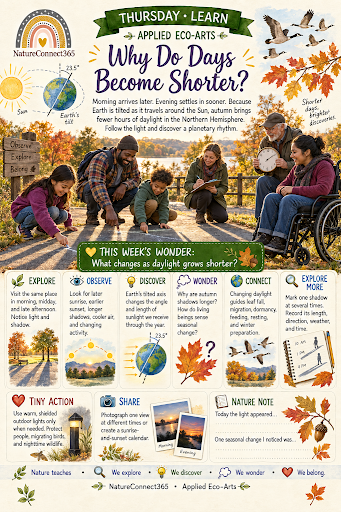
Morning arrives later. Evening settles in sooner. The Sun appears lower in the sky, and afternoon shadows stretch across the ground.
These changes are part of Earth’s yearly journey around the Sun. As the balance between daylight and darkness shifts, trees, plants, animals, and people respond.
Follow the light and discover why autumn days become shorter.
🌿 Explore
Choose one safe outdoor place that you can visit at different times.
Observe it:
shortly after sunrise
around midday
during the afternoon
near sunset
Notice:
where the Sun appears in the sky
the direction of the light
the length of shadows
areas that remain cool or shaded
the time outdoor lights turn on
when birds become active or quiet
how the temperature changes
how the sky’s colors shift
Never look directly at the Sun. Observe its light and shadows instead.
🔍 Observe
Return to the same place over several days or weeks.
Can you notice…
sunrise occurring later
sunset occurring earlier
shadows becoming longer
the Sun following a lower path
cooler mornings and evenings
leaves responding to reduced daylight
flowers closing at particular times
birds gathering, migrating, or changing activity
animals preparing for winter
people adjusting their daily routines
more time between sunset and sunrise
Changing daylight can be measured, but it can also be felt through the rhythms of daily life.
💡 Discover
Earth travels around the Sun once each year while rotating once each day.
Earth’s axis—the imaginary line between the North and South Poles—is tilted. Because of this tilt, different parts of Earth receive different angles and lengths of sunlight throughout the year.
During autumn in the Northern Hemisphere, our part of Earth gradually tilts farther away from the Sun. The Sun appears lower in the sky and follows a shorter path from sunrise to sunset. This gives us fewer hours of daylight and longer nights.
The seasons are not caused by Earth moving significantly closer to or farther from the Sun. They are primarily caused by Earth’s tilt and its position during its yearly orbit.
In the Southern Hemisphere, the seasonal pattern is reversed: when the Northern Hemisphere experiences autumn, the Southern Hemisphere experiences spring.
💭 Wonder
How has the time of sunset changed since summer?
Why are shadows longer in autumn?
Why does the Sun appear lower in the sky?
How does Earth’s tilt create seasons?
Why are the seasons opposite in the two hemispheres?
How do trees respond to shorter days?
How do animals detect seasonal change?
What happens after the shortest day of the year?
How does changing daylight affect your daily rhythm?
Light connects the movement of Earth with the seasonal lives of plants, animals, and people.
🌎 Connect
Day length is an important ecological signal.
Plants and animals respond to the changing relationship between daylight and darkness. This seasonal light cycle can influence:
leaf color and leaf fall
flowering and seed dormancy
bird migration
insect activity
hibernation and winter preparation
animal coats and camouflage
feeding and resting patterns
reproduction
daily sleep and waking rhythms
Temperature and weather also matter, but changing day length is especially dependable because it follows Earth’s yearly movement.
Every autumn sunset is part of a much larger planetary rhythm.
🌈 Explore More
Create a shadow-and-daylight investigation.
Place a natural marker or removable chalk mark at the end of a shadow cast by the same stationary object at several times during the day.
Record:
the time
shadow direction
shadow length
temperature
weather
observations of plants or animals
Repeat the investigation one week later. Compare the results.
You can also:
create a sunrise-and-sunset calendar
photograph the same view at the same time each week
make a seasonal light watercolor
compare day length in two different locations
use a globe and flashlight to model Earth’s tilt with adult support
notice which windows receive autumn sunlight
Keep walkways clear, use only removable markings, and never look directly at the Sun.
❤️ Tiny Action
Welcome darkness with care for the night.
Use outdoor lighting only where it is needed. Choose warm, shielded lights directed toward the ground, and turn them off when they are no longer necessary.
Reducing unnecessary nighttime light can:
help migrating birds navigate
protect moths and other nocturnal insects
support bats and nighttime pollinators
preserve human sleep rhythms
reduce energy use
help communities see the stars
Keep paths safely illuminated while protecting nearby habitat. Thoughtful light can support both people and the living world.
📸 Share
Photograph the same outdoor view at different times of day.
Create a shadow tracing, sunset color study, daylight calendar, or seasonal wheel.
Invite someone to compare sunrise and sunset times with you.
Share:
one change you noticed in the light
one living being responding to shorter days
one discovery about Earth’s tilt
one way to care for the nighttime environment
📝 Nature Note
Today the Sun appeared…
The shadow changed by…
Sunset happened at…
One plant or animal responding to shorter days was…
As darkness arrives earlier, I notice…
One question I still have about Earth’s seasons is…
#NatureConnect365 #AppliedEcoArts #ThursdayLearn #ShorterDays #ChangingLight #EarthsTilt #AutumnScience #SeasonalRhythms #OutdoorLearning #NatureConnection #DarkSky #Wonder