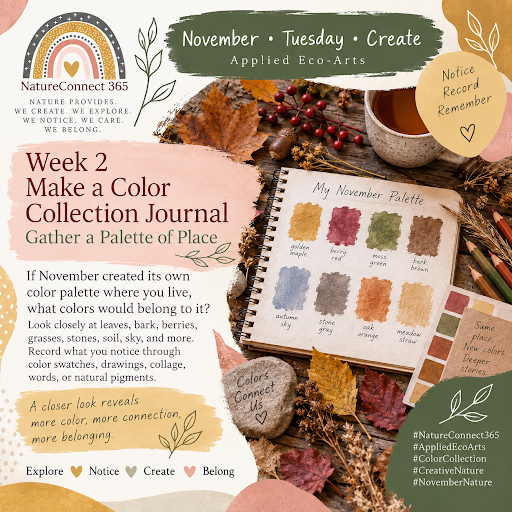
Gather a Palette of Place
If November created its own color palette where you live, what colors would belong to it?
Create a small Color Collection Journal inspired by the colors you encounter outdoors. Look closely at fallen leaves, bark, berries, grasses, seed heads, stones, soil, clouds, water, evergreen plants, garden remnants, and changing light.
Record what you discover through color swatches, natural pigments, drawing, collage, words, or descriptive color names of your own invention.
Your journal does not need to match nature perfectly.
Let it become a record of what you noticed in this place, at this moment, during this season.
🌱 Materials
Small sketchbook, notebook, or handmade journal
Reclaimed paper or cardstock for making your own journal
Pencil
Colored pencils
Watercolor paints
Paintbrushes
Small container of water
Nontoxic markers or crayons
Natural pigments or dyes from Week 1, if available
Scrap paper for testing colors
Glue stick or nontoxic craft glue
Scissors
Clipboard or firm surface for working outdoors
Reusable collection envelope or small container
Magnifying glass, if available
Camera or phone for documenting colors without gathering
Optional paint-chip-style paper strips
Optional ruler
Optional hole punch and natural cord for binding loose pages
Journal or writing paper
Safety Note: Observe unknown plants, berries, fungi, and other natural materials without touching or tasting them. Some plants can irritate skin or be toxic. Gather only where permitted and only materials you can safely identify. Natural pigments and art materials should not be eaten. Supervise young children around small materials, scissors, water, and art supplies.
✨ Create
1 • Begin Without Naming the Colors
Choose an outdoor place to explore.
It might be:
A backyard
A garden
A schoolyard
A neighborhood
A park
A woodland edge
A beach
A trail
A community garden
A view from a window
Before opening your journal, spend a few moments simply looking.
Try not to immediately decide:
That is brown.
That is green.
That is gray.
Look again.
How many different browns are present?
How many greens remain?
Is the sky one gray—or many?
November often asks us to notice distinctions that brighter seasons can hide.
2 • Search for a November Palette
Begin looking for colors that belong to this particular place today.
Notice:
Fallen leaves
Tree bark
Twigs
Moss
Lichens
Evergreen needles
Dried grasses
Seed heads
Berries
Soil
Stones
Water
Clouds
Garden remnants
Fences and weathered wood
Shadows
Sunlight
Reflections
Colors changed by rain
Try finding at least five different colors.
Then see whether you can find ten.
There is no required number.
The purpose is to discover how much variation appears when you slow down enough to see it.
3 • Choose One Color That Draws You
Rather than trying to record everything, notice which color holds your attention.
Move closer if it is safe to do so.
Ask:
Is it warm or cool?
Bright or muted?
Light or dark?
Uniform or varied?
Glossy or matte?
Transparent or opaque?
Does it change when you move?
Does sunlight alter it?
Does its color change when wet?
Are other colors hidden inside it?
Try to recreate the color in your journal.
It does not have to match perfectly.
Your interpretation is part of the observation.
4 • Make a Color Swatch
Create a small square, circle, stripe, brushstroke, or other mark representing the color you noticed.
You might use:
Colored pencil
Watercolor
Crayon
Marker
Natural pigment
Botanical dye from Week 1
Collaged paper
A combination of materials
Experiment with layering colors rather than relying on a single art material.
Try adding brown to red.
Yellow to gray.
Blue beneath green.
Water to deepen or soften watercolor.
Notice what happens when you try to mix toward what you actually see rather than toward what you think the color should be.
5 • Give the Color a Name
Now name your color.
You may use an ordinary color word—or invent something more connected to your experience.
Instead of simply:
Brown
perhaps it becomes:
Wet Oak Bark
Acorn Cap
Garden Soil
Rain-Dark Branch
Fallen Fern
November Earth
Instead of:
Gray
perhaps:
November Morning
Cloud Before Rain
Smooth Stone
Quiet Sky
Weathered Wood
Instead of:
Red
perhaps:
Berry After Frost
Maple Ember
Rose Hip Red
Last Leaf
Autumn Flame
A color name can become a small piece of place-based storytelling.
6 • Record Where You Found It
Beside your color swatch, record something about its place.
You might write:
Found on:
Growing beside:
Weather:
Time of day:
Light:
Texture:
Nearby colors:
What drew my attention:
You can also sketch the plant, stone, landscape feature, or other source of the color.
This transforms your journal from a collection of colors into a record of relationships between color and place.
7 • Collect Without Always Gathering
Some colors can be recorded without bringing anything home.
Photograph a berry.
Sketch a patch of moss.
Mix the color of a bird’s feather while leaving the bird undisturbed.
Record the color of bark without removing it.
Paint the sky.
Draw the green of a living leaf while allowing it to remain attached.
Notice a stone and leave it where you found it.
Your journal can hold an experience without possessing the material that inspired it.
8 • Create a November Color Page
After gathering several observations, arrange them together on one page.
Create your own November Palette of Place.
For example:
🍂 Wet Oak Bark
🌾 Meadow Straw
🌫️ November Morning
🌲 Quiet Evergreen
🍒 Berry After Frost
🪨 Rainwashed Stone
🌱 Moss Shadow
🍁 Maple Ember
Arrange the colors:
Light to dark
Warm to cool
Bright to muted
In the order you discovered them
By natural material
By location
In a circle
As a seasonal gradient
In a pattern of your own
There is no single correct November palette.
Every place—and every observer—may create a different one.
9 • Return to One Place
If possible, revisit the same place later in the week.
Bring your journal.
Look for the colors you recorded previously.
Ask:
Are they still here?
Perhaps a leaf has fallen.
Rain has darkened the bark.
A berry has disappeared.
The sky has changed.
Frost has altered a garden.
Sunlight has transformed a color you thought you already knew.
Add a second swatch or observation beside the first.
Your journal can record not only color, but color changing through time.
🎨 Create with Your Color Collection
Use your journal to:
Make a November palette
Create a seasonal color wheel
Build a color gradient
Invent place-based color names
Compare several outdoor locations
Create watercolor studies
Make natural pigment swatches
Pair colors with short poems
Create a color-and-texture page
Record weather through color
Compare morning and afternoon light
Make a tree color study
Create a bark palette
Document colors after rainfall
Build a seasonal color vocabulary
Choose colors for next week’s Botanical Bundle Wrapping
🔍 Notice
Pay attention to:
Colors that initially looked the same
Variations within brown, gray, and green
Colors hidden inside dried plants
Differences between wet and dry surfaces
Colors altered by sunlight
Colors changed by shadow
Contrasts between neighboring materials
Colors that appear only from certain angles
Bright colors within an otherwise muted landscape
Repeating colors across different species
Relationships between color and texture
Colors that are difficult to reproduce
Changes from one visit to another
Which colors repeatedly attract your attention
Notice whether looking for color changes how you experience a familiar place.
💭 Wonder
Why does the same color look different in sunlight and shadow?
Why do wet leaves and bark often appear darker?
How many colors can exist within something we call “brown”?
Why do some plants remain green into late autumn?
What creates color in berries, leaves, bark, and flowers?
How does November’s palette differ from October’s?
Does the sky influence how we perceive colors on the ground?
Can we remember a place through color?
Why are some colors difficult to recreate with art materials?
How does naming a color change the way we notice it?
Do different people notice the same colors?
What colors might an animal perceive differently from us?
How quickly can the palette of one place change?
🌎 Connect
Color is created through relationships among light, materials, surfaces, and perception.
Objects do not simply contain the exact colors we experience. Light reaches a surface, some wavelengths are absorbed, and others are reflected toward our eyes. Our visual system interprets that reflected light as color.
This means the color we perceive can change with conditions.
A leaf may appear different beneath bright sunlight, cloud cover, evening light, or rain. A rough piece of bark creates tiny areas of light and shadow. Water can alter how light interacts with a surface, often making colors appear deeper or darker.
Plants also contain pigments that contribute to their visible colors. Chlorophyll contributes green, carotenoids contribute many yellows and oranges, and anthocyanins can contribute reds and purples in some plant tissues.
By late autumn, the landscape may seem less colorful than it did several weeks earlier.
But when we look closely, color has not disappeared.
The palette has changed.
🌈 Explore Further
Create a five-color palette from one tree.
Compare bark colors from several tree species.
Record colors before and after rain.
Make a palette using only fallen materials.
Compare morning and evening colors.
Photograph one place each week.
Create a page devoted entirely to shades of brown.
Search for unexpected November greens.
Mix paints to match stones without collecting them.
Research pigments found in autumn plants.
Create a color vocabulary unique to your neighborhood.
Pair each color with a sensory word.
Compare your palette with another person’s.
Create a color map of a familiar walk.
Revisit the same place in winter and compare its palette.
📸 Share
Photograph a page from your Color Collection Journal or create an arrangement showing your November palette beside the place that inspired it.
Share:
The place you explored
A color that surprised you
Your favorite invented color name
A color that was difficult to recreate
Something you noticed after slowing down
A color that changed with the weather
The most common color you found
The rarest color you discovered
A color you want to explore further
The name of your November palette
Share with #NatureConnect365 and invite others to discover the colors of November where they live.
❤️ Tiny Action • Big Impact
Practice collecting color without collecting nature.
Instead of removing a leaf, flower, stone, piece of bark, moss, or berry, try recording its color through a photograph, sketch, color swatch, or descriptive word.
Many natural materials remain important after we notice them.
Leaves protect soil and shelter small beings. Berries may provide food. Bark protects trees. Moss and lichens are living communities. Stones can provide tiny shelters and influence soil and water.
Your journal can help you carry the memory of a color home while allowing the original material to remain where it belongs.
Notice more. Take less. Leave habitat in place.
📝 Nature Note
The place I explored was:
The weather was:
The first color I noticed was:
The color that kept drawing my attention was:
I named that color:
A color that surprised me was:
The most difficult color to recreate was:
When the light changed, I noticed:
One color I recorded without gathering was:
My November palette feels:
A color I would like to carry into next week’s Botanical Bundle Wrapping is:
I named my November palette:
#NatureConnect365 #AppliedEcoArts #NatureJournal #ColorJournal #NatureJournaling #NatureArt #NovemberNature #AutumnColors #NatureStudy #CreativeNature #NatureConnection #SeasonalJournal #PlaceBasedLearning #SlowLooking #NatureInspired