🩵 Collection Jar
Curiosity Through Gathering
Story Through Small Things
Belonging Through Place
Applied Eco-Arts Learning Series | Summer Nature Collection Practice
🌞 Overview
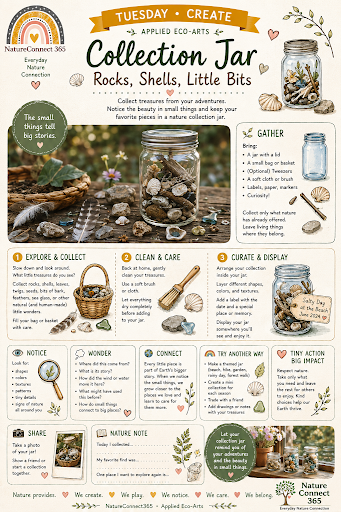
Collection Jar invites participants to explore the stories held within the small treasures they discover outdoors.
Rather than collecting for the sake of having more, participants gather thoughtfully and respectfully, choosing only naturally fallen or abundant items that have already been offered by the landscape. Rocks, shells, feathers, seed pods, pinecones, driftwood, acorn caps, sea glass, bark, and other small natural objects become reminders of moments spent in relationship with a place.
The practice begins with wandering slowly and noticing what draws your attention. Participants gather a few meaningful objects, gently clean and care for them, then arrange them inside a clear jar to create a personal collection. Labels, drawings, journal entries, and stories help transform the collection into a living record of curiosity, memory, and relationship.
As participants work with their hands, the collection jar becomes more than a container. It becomes a record of interaction between place, season, observation, memory, gratitude, and care.
This practice supports sensory exploration, scientific observation, creative expression, ecological awareness, reflective thinking, storytelling, stewardship, and a growing sense of belonging with local landscapes.
🍁 Learning Focus
Participants are invited to:
Observe small details that are often overlooked.
Gather natural objects respectfully and responsibly.
Notice relationships between materials, habitats, and seasonal change.
Practice scientific observation alongside creative expression.
Develop sorting, comparing, and classification skills.
Strengthen attention through collecting, arranging, and documenting.
Reflect on how everyday objects hold stories of place.
Build belonging through repeated visits to local landscapes.
🧭 Materials
Core Materials
Clear glass jar with lid
Small basket or cloth bag
Pencil
Nature journal or notebook
Optional Materials
Magnifying glass
Soft brush or cloth
Labels or tags
Colored pencils or watercolor
Camera (optional)
☀️ Creative Process Invitation
1. Arrive
Choose a place to explore.
Walk slowly.
Allow curiosity to guide your attention.
Notice what the landscape has already offered.
2. Gather with Care
Collect only naturally fallen or abundant materials.
Examples include:
Rocks
Shells
Seed pods
Pinecones
Acorn caps
Feathers (where permitted)
Driftwood
Sea glass
Bark pieces
Dried leaves
Leave living plants, nests, and wildlife undisturbed.
3. Notice
Ask yourself:
What attracted me first?
Why did I choose this object?
What textures do I notice?
What colors appear in sunlight?
Where might this have come from?
4. Curate
Arrange your discoveries inside your jar.
Experiment with:
color
size
texture
shape
pattern
Give your collection a title.
Add a label with the date and location.
5. Record
Write or draw:
Today’s favorite discovery
Where each object was found
Weather
Sounds
Questions that emerged
A memory connected to the place
6. Reflect
Hold your completed jar.
Notice:
Which object feels most meaningful?
What story does your collection tell?
What relationships became visible?
How has your way of seeing this place changed?
🌎 EcoSoma Connections
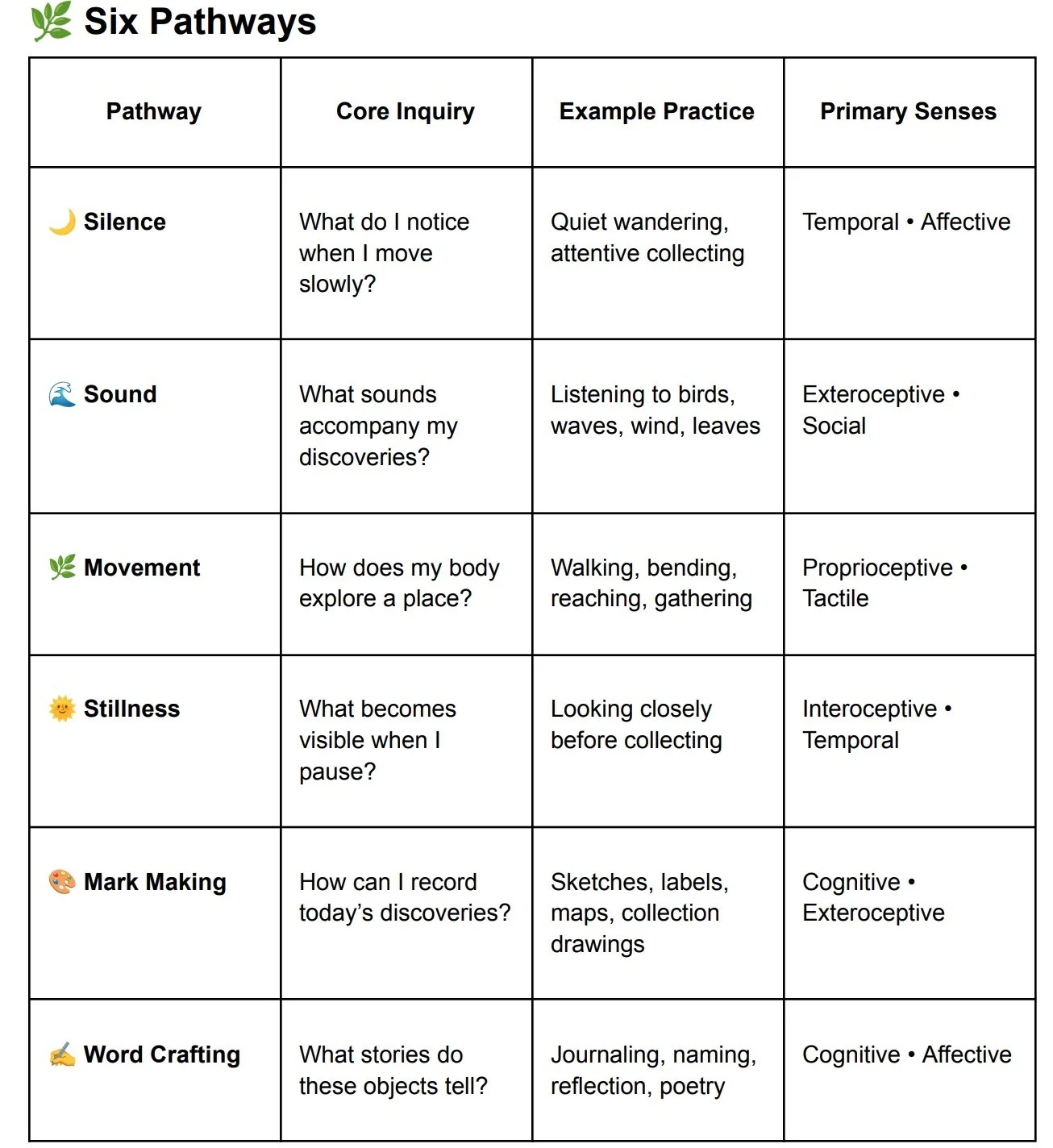
While gathering, notice which EcoSoma Sense families become active.
🫀 Interoceptive — How does my body feel as I move and explore?
🌿 Exteroceptive — What textures, colors, scents, and sounds draw my attention?
💛 Affective — Which discoveries bring joy, curiosity, gratitude, or wonder?
🤝 Relational — How do these small objects help me feel connected with this place?
🧠 Meaning-Making — What larger story emerges from these small pieces?
⏳ Temporal — What clues tell me about seasons, weather, or time?
🌱 Agency — How can I gather respectfully and care for this place?
These reflections encourage participants to experience collecting as a practice of relationship, where observation, body, emotion, meaning, and stewardship come together.
02. Chapter 2:EcoSoma Senses and Natural Attraction Ecology.pdf
♻ Sustainability Connection
Collection Jar reminds us that meaningful discoveries do not require buying new materials.
Participants experience:
low-impact nature exploration
appreciation for naturally found objects
careful, ethical gathering
creative reuse of glass jars
gratitude for everyday beauty
stewardship through leaving places healthy for others
The most valuable part of the collection is not what is inside the jar—it is the relationship that grew while gathering.
🌞 Seasonal Variations
🌸 Spring — Buds, blossoms, seed wings, fresh leaves.
☀ Summer — Shells, feathers, driftwood, wildflowers (fallen), colorful stones.
🍂 Autumn — Acorns, pinecones, seed pods, colorful leaves, nuts.
❄ Winter — Pine needles, bark, evergreen cones, smooth stones, winter grasses.
🌱 Extensions
Participants may expand this activity into:
Seasonal collection jars
Beach treasure collections
Forest discovery jars
Watershed investigations
Nature museums
Family memory jars
Classroom curiosity collections
Story jars with poems and drawings
Place-based field journals
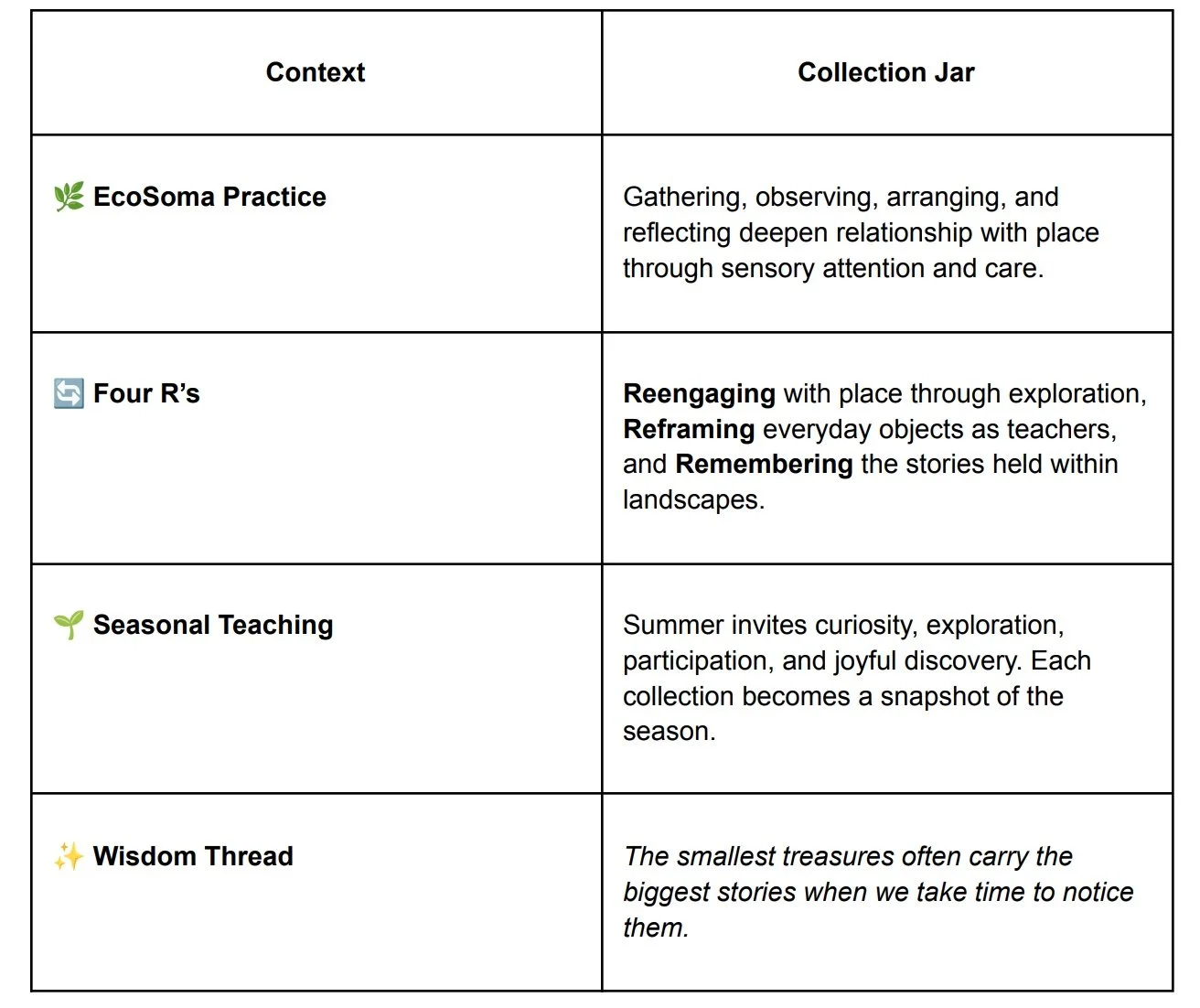
🪞 Applied Eco-Arts Context
🧡 Reflection
Every pebble has traveled.
Every shell has a history.
Every feather has ridden the wind.
When we slow down enough to notice the small things, we begin to discover that no object exists alone. Each one carries the story of weather, water, time, movement, and place.
Sometimes belonging begins with something as simple as a single stone held carefully in your hand.
One small discovery can open the door to seeing the whole landscape with new eyes.
Nature teaches • We explore
We discover • We wonder •
We belong.
NatureConnect365 · Applied Eco-Arts