🩵 Place Mapping
Identity as Relationship · Memory as Landscape · Belonging Through Place
Applied Eco-Arts Learning Series | Summer Sensory Mapping Practice
🌞 Overview
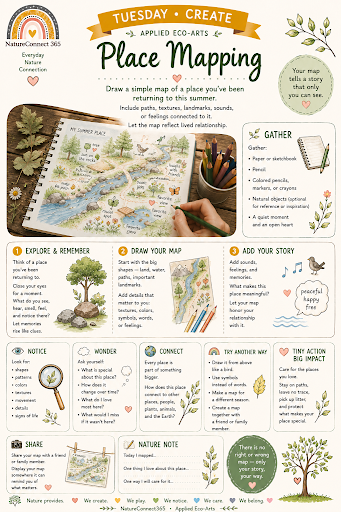
Place Mapping invites participants to explore their relationship with a place they have returned to throughout the season.
Using paper, pencils, colored pencils, crayons, markers, and optional natural materials for inspiration, participants create a hand-drawn map that reflects lived experience rather than geographic accuracy. The practice begins with remembering, then moves through observing, sketching, layering, labeling, reflecting, and sharing.
Instead of simply recording where things are, participants notice how a place has become meaningful through repeated encounters. A favorite tree, the sound of birds, a shaded path, a sunny rock, a flowing stream, textures beneath their feet, seasonal changes, and personal memories gradually become part of the landscape.
As the map develops, it becomes a living record of relationship between body, memory, place, season, and Earth. Every line reflects attention. Every symbol carries a story. The finished map honors belonging rather than direction.
This practice supports observation, ecological awareness, spatial thinking, storytelling, creative expression, memory, emotional connection, and place-based learning.
🍁 Learning Focus
Participants are invited to:
• Observe familiar places with fresh attention.
• Notice relationships between natural features and personal experience.
• Develop spatial awareness through creative mapping.
• Practice careful observation and visual storytelling.
• Recognize that places become meaningful through relationship over time.
• Express memories, emotions, sounds, textures, and seasonal experiences visually.
• Strengthen ecological identity through repeated encounters with place.
• Experience mapping as an act of noticing rather than measuring.
🌿 EcoSoma Sense Families
This activity especially engages:
👁️ Exteroceptive
noticing light
colors
textures
sounds
landmarks
movement
❤️ Affective
belonging
comfort
wonder
gratitude
emotional memory
🤝 Social / Relational
relationship with place
connection to living communities
reciprocity
care
🧠 Cognitive
spatial thinking
memory
pattern recognition
visual organization
⏳ Temporal
noticing seasonal change
remembering previous visits
observing continuity over time
🌱 Agency
choosing what feels meaningful
caring for a favorite place
recognizing personal responsibility
The activity naturally supports multiple EcoSoma Sense families as participants move between observation, memory, meaning-making, and care.
EcoSoma-SI scoring guide & EcoSoma Sense index.pdf
🌎 Materials
Gather
• sketchbook or paper
• pencil
• colored pencils, crayons, or markers
• clipboard (optional)
• natural objects for inspiration (optional)
• a comfortable place to sit
• curiosity
🌼 Activity Steps
1. Return
Think of a place you have visited more than once this season.
Perhaps it is:
• a favorite tree
• a creek
• a shoreline
• a garden
• a park
• a backyard
• a hiking trail
• a neighborhood corner
Spend a quiet moment remembering the place before you begin drawing.
2. Observe
Imagine yourself standing there.
Notice:
• shapes
• pathways
• water
• rocks
• trees
• plants
• sunlight
• shadows
• sounds
• textures
• favorite resting places
Ask:
What makes this place feel familiar?
3. Sketch the Landscape
Begin with the largest features.
Draw:
• land
• water
• pathways
• trees
• buildings
• gardens
• hills
• landmarks
Accuracy isn’t the goal.
Relationship is.
4. Add the Living Details
Now include what only you might notice.
Perhaps:
• birdsong
• butterflies
• breezes
• favorite flowers
• footprints
• textures
• seasonal colors
• places you like to sit
• favorite discoveries
Use:
• symbols
• colors
• words
• arrows
• simple illustrations
5. Tell the Story
Add words around your map.
Examples:
“I always hear chickadees here.”
“This tree gives wonderful shade.”
“I come here when I need quiet.”
“The stream sounds different after rain.”
“Sunlight reaches this rock every morning.”
Allow the landscape and your experience to speak together.
6. Reflect
Give your map a title.
Finish these prompts:
Today I mapped…
One thing I love about this place…
One way I will care for this place…
👀 Notice
Look for:
• repeating patterns
• changing light
• sounds
• movement
• textures
• signs of wildlife
• evidence of seasonal change
• places that invite you to pause
💭 Wonder
• What draws me back here?
• What has changed since my last visit?
• What stays the same?
• How does this place care for other living beings?
• What is this place teaching me?
🌍 Connect
Every place belongs to a larger living system.
Notice how your place connects with:
• water
• weather
• plants
• insects
• birds
• animals
• people
• seasons
• the wider landscape
🌈 Try Another Way
• Draw your map from above like a bird.
• Create a memory map instead of an exact map.
• Use only symbols.
• Draw your place during another season.
• Make a collaborative map with family or friends.
• Add sounds using words or musical symbols.
❤️ Tiny Action • Big Impact
Care for the places you love.
Stay on established paths.
Leave no trace.
Pick up litter if it is safe to do so.
Protect plants and wildlife.
Share what makes this place special with someone else.
Small acts of care help places continue to thrive.
📖 Nature Note
Today I mapped ___________________________
One thing I discovered _____________________
One thing I appreciate _____________________
One way I will care for this place _____________
🌿 Facilitator Reflection
This activity emphasizes relationship over representation. Encourage participants to notice what matters most to them rather than striving for accurate scale or precise geography. Invite maps that include feelings, memories, sounds, textures, colors, seasonal changes, and stories alongside physical features. In Applied Eco-Arts, a place map becomes a visual expression of ecological belonging—a record of attention, memory, and reciprocity shaped through repeated encounters with the living world.
We pause. • We remember. •
We give thanks. • We carry care forward.
NatureConnect365 · Applied Eco-Arts