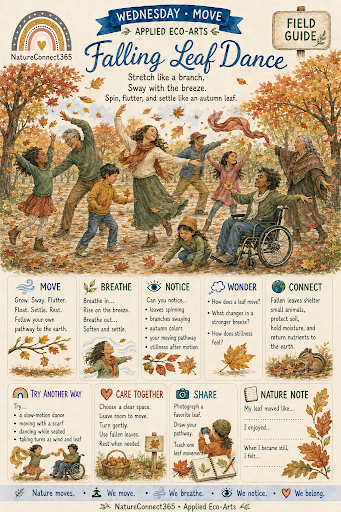
🍂 Falling Leaf Dance
Wednesday · Move
Invitation
Stretch like a branch.
Sway with the breeze.
Spin, flutter, and settle like an autumn leaf.
👣 Move
Dance Like a Falling Leaf
Find a safe outdoor space beneath or near autumn trees.
Choose one fallen leaf to observe.
Notice its shape, edges, stem, colors, and patterns.
Imagine the leaf’s journey from branch to ground.
Begin your dance:
1 · Grow
Stand or sit tall like a tree.
Reach your arms outward like branches.
Stretch your fingers like leaves meeting the sunlight.
2 · Sway
Let a gentle imaginary breeze move through your body.
Sway from side to side.
Move your arms slowly overhead.
3 · Flutter
Wiggle your fingers and hands.
Let small movements travel through your arms and shoulders.
Imagine the leaf beginning to loosen from its branch.
4 · Float
Turn, roll, glide, or travel gently through the space.
Move high, low, forward, backward, or in a circle.
Follow your own pathway through the autumn air.
5 · Settle
Slow your movement.
Lower toward the earth in a way that feels comfortable.
Become still like a leaf resting on the ground.
Pause before beginning the dance again.
🌿 Breathe
Leaf-in-the-Breeze Breathing
Hold a fallen leaf or rest your hands gently in your lap.
Breathe in…
Lift your arms like a leaf rising on the breeze.
Breathe out…
Lower your arms as the leaf drifts toward the earth.
Breathe in…
Lengthen and open.
Breathe out…
Soften and settle.
Repeat three to five times.
Notice how your breath creates movement, even when the rest of your body is still.
👀 Notice
Can you notice…
🍂 leaves fluttering, spinning, gliding, or tumbling
🌬️ how the wind changes a leaf’s direction
🌳 branches bending and swaying
🎨 red, orange, yellow, green, and brown leaves
☀️ sunlight moving through thinning branches
👣 the pathway your body creates
🌀 circles, curves, spirals, and zigzags
✋ small movements in your fingers and hands
💓 where you feel movement inside your body
👂 the sound of dry leaves beneath your feet or wheels
🤫 the quiet that arrives when your dance becomes still
🌎 leaves gathering on the earth beneath the trees
No two leaves—and no two dances—move in exactly the same way.
💭 Wonder
How does a leaf move when the wind is gentle?
How might it move during a stronger breeze?
Which part of your body feels most like a fluttering leaf?
What pathways can your leaf dance create?
How does it feel to move quickly? Slowly?
What changes when your movement becomes still?
Why do some trees release their leaves in autumn?
What happens to leaves after they reach the ground?
How can letting go make space for rest or change?
What did your body discover during the dance?
🌎 Connect
In autumn, many deciduous trees prepare for winter by releasing their leaves.
As daylight decreases and temperatures cool, trees gradually stop sending as much water and energy to their leaves. Green chlorophyll fades, revealing yellow, orange, and red pigments that were already present or newly produced.
When leaves fall, they do not simply disappear. They create shelter for insects and other small animals, protect the soil, hold moisture, and gradually decompose. Their nutrients return to the earth and support future growth.
A falling leaf dance helps us experience this seasonal change through the body.
By stretching, swaying, releasing, and resting, we join the movement of autumn and discover that change can include beauty, transformation, and renewal.
🌈 Try Another Way
Try…
dancing with an autumn-colored scarf
holding a fallen leaf as you move
following the movement of one leaf through the air
creating a slow-motion leaf dance
moving to gentle instrumental music
dancing without music and listening to outdoor sounds
taking turns being the wind and the leaf
creating a leaf dance with a partner
moving in a group like a swirling pile of leaves
making small leaf movements with your hands and fingers
dancing entirely from a seated position
tracing spirals and curves through the air
changing direction whenever the wind changes
ending the dance in a shared circle of stillness
repeating the dance with gentle, lively, and quiet movements
Every body can discover its own way to flutter, float, turn, and rest.
❤️ Care for Yourself and Others
Choose a level area free from holes, sharp branches, slippery leaves, and other hazards.
Check that the space is wide enough for everyone to move comfortably.
Keep a generous distance between dancers.
Turn and spin only at a speed that feels steady and safe.
Use seated movements if standing, bending, or turning is uncomfortable.
Lower toward the ground only when it supports your body.
Avoid throwing leaves toward anyone’s face.
Gather only fallen leaves and leave living branches undisturbed.
Check leaves before handling them and avoid unfamiliar or irritating plants.
Wear weather-appropriate clothing and supportive footwear.
Pause, rest, observe, or breathe whenever you wish.
Listen to your body and choose movements that feel comfortable.
📸 Share
Photograph your favorite fallen leaf.
Record a short section of your leaf dance.
Draw the pathway your body followed through the air.
Trace around a leaf and fill it with movement lines.
Create a group photograph of everyone posing like autumn trees.
Teach one leaf-inspired movement to another person.
Share the moment when your body felt most like a falling leaf.
Arrange fallen leaves in a temporary spiral to remember the dance.
📝 Nature Note
My leaf moved like…
The movement I enjoyed most was…
When my dance became still, I felt…
Autumn change reminds me…
#NatureConnect365 #FallingLeafDance #MoveWednesday #AppliedEcoArts #AutumnMovement #CreativeMovement #MoveLikeNature #SeasonalChange #MindfulMovement #NatureConnection #EveryBodyEveryDay #StartWhereYouAre #MoveWithTheSeason #AutumnLeaves