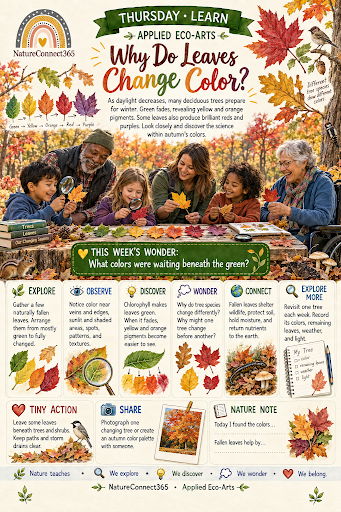
🍁 Why Do Leaves Change Color?
Discovering Pigments, Sunlight, and the Seasonal Life of a Tree
Invitation
Autumn trees reveal colors that have been present in their leaves all along.
As daylight decreases and temperatures change, many deciduous trees begin preparing for winter. Green fades. Yellow, gold, orange, red, and purple emerge. Eventually, leaves are released and return to the ground.
Look closely and discover the science inside autumn’s color.
🌿 Explore
Visit a place with several trees or shrubs.
Look for leaves that are:
completely green
beginning to yellow
green with colored edges
spotted or mottled
golden or orange
red or purple
brown and dry
resting on the ground
still attached to a branch
Gather only naturally fallen leaves where collection is permitted.
Arrange them from mostly green to fully changed. Can you create a color journey across the season?
🔍 Observe
Look closely at each leaf.
Can you notice…
several colors within one leaf
green remaining near the veins
edges changing before the center
yellow or orange appearing beneath green
red or purple patches
differences between sunlit and shaded leaves
tiny holes, trails, spots, or insect marks
dry, curled, soft, leathery, or brittle textures
veins branching like pathways
different tree species changing in different ways
leaves falling at different times
Return over several days and observe the same tree. Autumn color is a process, not a single moment.
💡 Discover
Leaves contain pigments—substances that absorb and reflect different colors of light.
Chlorophyll makes leaves appear green and helps plants use sunlight to make food. During summer, trees continually produce chlorophyll.
As autumn days become shorter, many deciduous trees begin preparing for winter. They produce less chlorophyll and recover useful nutrients from their leaves. As the green fades, yellow and orange pigments called carotenoids become easier to see. These pigments were present in many leaves throughout the growing season.
Some trees also produce red and purple pigments called anthocyanins. Sunlight, temperature, sugars, moisture, tree species, and weather conditions can influence how brilliant these colors become.
Eventually, a thin separation layer forms where the leaf stem meets the branch. The leaf is released, helping the tree conserve water and energy during winter.
💭 Wonder
Were autumn colors hiding beneath the green?
Why do different tree species produce different colors?
Why might one tree change before another?
Why does one side of a tree sometimes change first?
How do sunlight and temperature influence leaf color?
What happens inside the tree before a leaf falls?
Why do evergreen trees keep most of their needles?
What happens to fallen leaves on the ground?
Which animals depend on the leaf layer?
Changing leaves help us see how trees respond to their surroundings.
🌎 Connect
Leaf fall is not the end of a leaf’s ecological work.
Fallen leaves create shelter for insects, spiders, salamanders, caterpillars, fungi, and other small beings. They protect the soil from drying and erosion, hold moisture, and slowly return nutrients to the earth as decomposers break them down.
Some butterflies and moths spend winter as eggs, caterpillars, chrysalises, or cocoons within the leaf layer. Birds may search among the leaves for food.
The leaves a tree releases this year help nourish the soil that supports future growth.
🌈 Explore More
Create an autumn color investigation.
Choose one tree you can revisit. Observe it every few days and record:
the date
the amount of green remaining
newly visible colors
the number of leaves on the branches
the depth of leaves beneath the tree
recent temperature or weather
changes in sunlight and shadow
Create a watercolor strip, colored-pencil study, leaf map, photograph series, or simple color wheel.
You can also place a fallen leaf beneath paper and gently rub a crayon across the surface. Notice how the veins and edges appear.
Avoid pulling living leaves from branches when fallen leaves can support the investigation.
❤️ Tiny Action
Let fallen leaves continue their work.
Where it is safe and appropriate:
leave some leaves beneath trees and shrubs
move leaves from pavement into garden beds
create a small leaf shelter area
use leaves as natural mulch
compost excess leaves
avoid placing leaves in streets or storm drains
keep deep leaf piles away from building entrances and places where they create slipping hazards
A lightly managed leaf layer can protect soil and provide habitat while keeping paths accessible and safe.
📸 Share
Photograph one tree as its colors change.
Create an autumn color palette using paint, pencils, fabric scraps, or repeated leaf shapes.
Invite someone to compare two leaves with you.
Share:
the most surprising color you found
a tree you learned to recognize
one creature that depends on fallen leaves
one way your community can care for the leaf layer
📝 Nature Note
Today I found the colors…
The leaf changed first along…
One difference between two trees was…
Fallen leaves help the ecosystem by…
One question I still have about autumn color is…
#NatureConnect365 #AppliedEcoArts #ThursdayLearn #AutumnLeaves #LeafColor #Trees #SeasonalChange #LeaveTheLeaves #OutdoorLearning #NatureConnection #Wonder