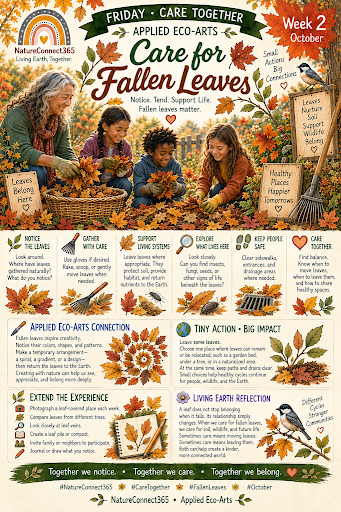
🍁Care for Fallen Leaves
🍂 🌎 Invitation
Autumn leaves are beginning to gather beneath trees, along paths, in gardens, and across neighborhood spaces.
It can be tempting to think of fallen leaves as something that simply needs to be cleaned away. But a fallen leaf is still part of the living landscape.
Leaves cover and protect soil. They slowly break down and return organic matter to the Earth. Beneath and among them, insects and other small creatures may find shelter as the season grows colder.
Today, spend time caring for fallen leaves with attention.
Notice where leaves can remain, where they need to be moved for safety or access, and where they might be gently relocated so they can continue participating in autumn’s cycle of change.
🌿 What You’ll Need
A place where autumn leaves have fallen
Gloves, if desired
A rake, broom, or leaf scoop, if needed
A basket, bucket, tarp, or reusable garden container
A garden bed, tree, shrub area, or other appropriate place for relocated leaves
Comfortable clothing for being outdoors
Curiosity about what lives beneath the leaves
💚 Care Together
Begin by walking slowly through your chosen place.
Before moving anything, notice where the leaves have naturally gathered.
Look beneath trees, beside shrubs, along fences, around garden beds, near paths, and in corners where the wind has carried them.
Then decide what kind of care each area needs.
You might:
Leave fallen leaves beneath trees or shrubs where appropriate.
Gently move leaves from a walkway or entrance.
Clear leaves that make a frequently used path slippery or difficult to navigate.
Keep storm drains and drainage areas clear.
Move suitable leaves into garden beds or other naturalized areas.
Create a small leaf pile in an appropriate undisturbed corner.
Crumble a dry leaf in your hands and notice how easily it begins returning to smaller pieces.
Compare newly fallen leaves with leaves that have already begun decomposing.
Pause before removing leaves and ask, Do these leaves actually need to go somewhere else?
Work gently.
The goal is not to make the landscape perfectly tidy. It is to care for both the people who use the space and the many other lives that share it.
👀 Notice
As you care for the leaves, ask yourself:
Where have the leaves gathered naturally?
Which leaves are dry, damp, curled, spotted, or already beginning to break apart?
What do you discover beneath them?
Can you find signs of insects, fungi, seeds, roots, or other life?
Which areas need to be clear for people?
Where could leaves remain without causing a problem?
How does the place feel when some leaves are allowed to stay?
Listen, too.
Notice the scrape of a rake, the crunch beneath your feet, the rustling of leaves in the wind, and the quieter sounds that become noticeable when you stop working.
🎨 Applied Eco-Arts Connection
Caring for fallen leaves can become a creative practice of observation, arrangement, movement, and relationship.
Before relocating leaves, notice their extraordinary variety.
Gold. Rust. Brown. Red. Green. Speckled. Curled. Torn. Veined.
You might arrange several leaves from light to dark, small to large, newly fallen to decomposing, or simply according to the pattern that attracts you.
Then return them to the landscape.
Applied Eco-Arts invites us to create without always needing to keep what we create. A temporary leaf arrangement can help us see something differently before the materials continue along their own seasonal path.
The artwork becomes part of noticing.
🌎 Tiny Action • Big Impact
Leave some leaves.
Rather than automatically removing every fallen leaf, identify one appropriate place where leaves can remain or be relocated.
A garden bed, the base of a tree, beneath shrubs, or another naturalized area may allow leaves to continue protecting soil and becoming part of the Earth again.
At the same time, caring for community spaces means keeping sidewalks, entrances, heavily traveled paths, and drainage areas safe and accessible.
Stewardship asks us to notice both needs.
Sometimes care means clearing.
Sometimes care means leaving things alone.
Learning the difference begins with attention.
🌱 Extend the Experience
Choose one small area where fallen leaves can remain through the season.
Photograph the same leaf-covered place each week and watch it change.
Compare leaves from several different trees.
Make a temporary color gradient or spiral with fallen leaves and then return them to the ground.
Look closely at leaf veins with a magnifying glass.
Search gently for signs of small creatures without disturbing their shelter.
Add suitable leaves to a compost pile.
Notice where wind naturally gathers leaves around your neighborhood.
Return later in autumn to see how your leaf pile or garden bed has changed.
Invite family members or neighbors to identify one place where leaves can safely remain.
🌼 Living Earth Reflection
A leaf does not stop belonging to the tree’s community when it falls.
Its relationship simply changes.
What once gathered sunlight above us settles onto the Earth below. What was green becomes gold, rust, and brown. What once moved in the canopy begins another slower transformation among soil, moisture, fungi, insects, roots, and weather.
Autumn invites us to care without assuming that care always means removing, fixing, or making tidy.
Sometimes caring means noticing what needs our help.
Sometimes it means moving something gently.
And sometimes it means recognizing that the living world is already doing exactly what it needs to do.
We notice what has fallen.
We care for what is shared.
We make room for the cycle to continue.
#NatureConnect365 #AppliedEcoArts #ThursdayLearn #AutumnLeaves #LeafColor #Trees #SeasonalChange #LeaveTheLeaves #OutdoorLearning #NatureConnection #Wonder