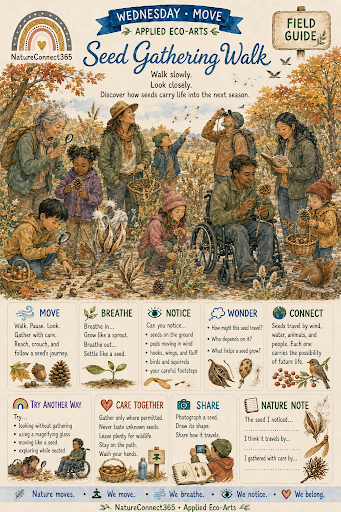
🌰 Seed Gathering Walk
Invitation
Walk slowly.
Look closely.
Discover how seeds carry life from one season into the next.
👣 Move
Walk, Pause, Gather
Choose a safe, familiar, and accessible place where seeds can be observed.
Bring a small basket, paper bag, collection tray, camera, or nature journal.
Begin walking slowly.
Move through the landscape using a simple rhythm:
Walk • Pause • Look • Gather
As you explore, you might:
reach upward toward seed heads
crouch beside fallen acorns or cones
follow a seed carried by the wind
trace the shape of a seedpod with your hands
step carefully around plants
stretch tall like a flower reaching toward the sun
curl into a small seed shape
open slowly like a sprouting plant
carry one permitted seed gently in your palm
stop to sketch or photograph a discovery
Gather only a few common, fallen seeds where collecting is permitted.
Leave attached seeds, unfamiliar berries, and most of what you find for plants, wildlife, and future growth.
End your walk by arranging your gathered seeds in a small circle.
🌿 Breathe
Seed-to-Sprout Breathing
Stand, sit, or rest in a comfortable position.
Curl your hands gently toward your heart as though you are a small seed resting beneath the soil.
Breathe in…
Imagine roots beginning to grow.
Breathe out…
Let your body settle toward the earth.
Breathe in…
Slowly lift your hands like a new shoot reaching upward.
Breathe out…
Open your arms like leaves meeting the light.
Repeat three times.
Notice how your breath can carry you from stillness into movement.
👀 Notice
Can you notice…
🌰 seeds resting on the ground
🌾 seed heads moving with the wind
🍂 leaves covering or protecting seeds
🌬️ seeds floating or tumbling through the air
🐦 birds gathering berries or carrying seeds
🐿️ squirrels collecting and hiding nuts
🪶 hooks, hairs, wings, or fluff that help seeds travel
🎨 the colors and patterns on seedpods
👣 how your body changes as you reach, bend, and crouch
✋ the textures of seeds held safely in your hand
🌱 places where a seed might begin to grow
💓 how slowing down changes what you discover
Each seed has a shape suited to its particular journey.
💭 Wonder
How many different kinds of seeds can you find?
What shapes, colors, sizes, and textures do you notice?
How might each seed travel?
Which seeds are carried by wind, water, animals, or people?
Why do some plants produce many seeds?
What animals depend on seeds for food?
What might help a seed begin to grow?
How does your body move differently when you search carefully?
What should we leave behind for wildlife and future plants?
What possibility might one small seed hold?
🌎 Connect
Seeds connect one season of growth with the next.
Some seeds drift on the wind. Others float on water, cling to fur, pass through animals, or are carried and planted by people. Acorns and nuts provide food for wildlife, while seedpods shelter developing seeds until they are ready to travel.
Many animals help plants spread. Birds carry berries, squirrels bury nuts, and people save seeds for gardens and habitat restoration. Some forgotten seeds eventually grow into new plants.
A seed-gathering walk helps us experience the landscape as a place filled with movement, preparation, and possibility.
Gathering respectfully means taking only what we need, observing before touching, and leaving plenty for wildlife, regeneration, and the living community of the place.
🌈 Try Another Way
Try…
following one windblown seed with your eyes
searching for seeds without collecting them
photographing a seed in the place where you found it
creating a seed-shape scavenger hunt
walking with a partner and sharing discoveries
comparing smooth, rough, fuzzy, winged, and prickly seeds
moving like a seed carried by wind or water
passing a seed carefully around a circle
making a temporary seed pattern on the ground
exploring from a seated position
bringing fallen seeds to an accessible observation table
using a magnifying glass to study tiny details
sketching seed shapes in a nature journal
sorting permitted seeds by size, color, texture, or traveling method
planting an appropriate native seed with guidance from a knowledgeable adult
Seeds may be gathered through walking, observing, photographing, drawing, storytelling, or imaginative movement.
❤️ Care for Yourself and Others
Gather only where collecting is permitted.
Choose common, fallen seeds rather than removing seeds from living plants.
Never taste unfamiliar seeds, nuts, pods, or berries.
Avoid touching plants that may be poisonous, irritating, or protected.
Ask a knowledgeable adult or guide before handling unfamiliar plants.
Leave plenty of seeds for birds, insects, mammals, future plants, and other visitors.
Do not gather rare, threatened, or protected species.
Remain on established paths where needed to protect sensitive habitats.
Choose an accessible route with stable, clearly marked surfaces.
Wear weather-appropriate clothing and sturdy footwear.
Check clothing and skin for ticks after exploring grassy or wooded areas.
Wash your hands after handling natural materials.
Move slowly, rest when needed, and gather in ways that support your body.
📸 Share
Photograph your favorite seed in the place where you found it.
Arrange permitted seeds by shape, size, color, or texture.
Draw a map showing where different seeds were discovered.
Create a temporary spiral, circle, or pathway with gathered seeds.
Sketch one seed from several different angles.
Record a short video of seeds moving in the wind.
Teach someone how one particular seed travels.
Share one way you practiced respectful gathering.
Return appropriate seeds to the place where they were found after observing them.
📝 Nature Note
The seed that surprised me most was…
I think this seed travels by…
My body moved like a seed when…
One way I gathered with care was…
#NatureConnect365 #SeedGatheringWalk #MoveWednesday #AppliedEcoArts #AutumnSeeds #MindfulWalking #GatherWithCare #SeedStories #SeasonalRhythms #NatureDiscovery #NatureConnection #EveryBodyEveryDay #StartWhereYouAre #MoveWithNature #LeavePlentyForWildlife