🌰 · Make an Acorn Garland
Invitation
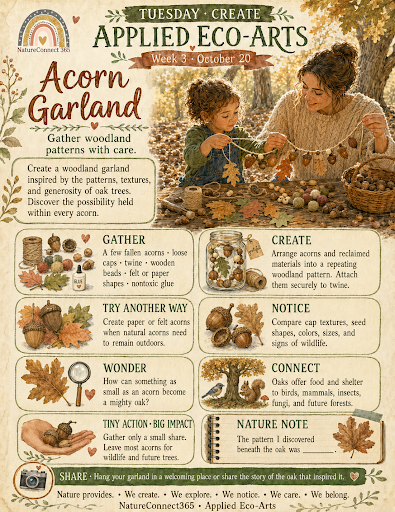
Gather a modest collection of fallen acorns and caps from a place where collecting is permitted. Combine them with reused and natural materials to create a woodland garland inspired by the patterns, textures, and generosity of oak trees.
Discover how one small acorn can hold food, habitat, memory, and the possibility of a future forest.
🌱 Materials
A small number of fallen acorns and acorn caps
Reclaimed paper, cardboard, or fabric
Wooden beads or felted wool balls
Fallen leaves, if desired
Twine, cotton cord, or reused ribbon
Nontoxic craft glue
Small paintbrush
Nontoxic paint or paint markers
Pencil or chalk
Blunt tapestry needle
Hand drill or awl for adult use, if needed
Small basket or cloth bag
Dry brush or cloth
Reusable work mat
Journal or sketch paper
Safety Note: Adults should inspect all natural materials for mold, sharp points, insects, and animal activity. Adults should make any holes and supervise adhesives and small parts. Acorns and beads can be choking hazards and are unsuitable for unsupervised use by young children. Wash hands after handling natural materials.
✨ Create
1 • Meet an Oak
Visit an oak tree or woodland edge. Spend time beneath its branches before gathering.
Look for:
Acorns with and without caps
Different shapes and sizes
Leaves with rounded or pointed lobes
Bark patterns
Mosses and lichens
Holes made by insects
Animal tracks or feeding signs
Young oak seedlings
Acorns beginning to sprout
Listen for birds and squirrels that may also be visiting the tree.
2 • Gather Thoughtfully
Collect only a modest handful of clean, fallen acorns and loose caps.
Choose materials that are:
Already separated from the tree
Dry and firm
Free from visible mold
Free from active insects
Comfortable to handle
Gathered where collection is allowed
Leave plentiful acorns for wildlife, natural decomposition, and future oak trees. Allow acorns in parks, preserves, protected areas, and posted locations to remain in place.
3 • Study the Collection
Arrange the acorns and caps on a work surface.
Compare:
Length and width
Round and elongated forms
Cap depth
Smooth and textured surfaces
Light and dark browns
Attachment points
Signs of nibbling or boring
Differences that may indicate several oak species
Sketch one acorn at a larger scale. Include the cap, shell, point, and subtle changes in color.
4 • Clean and Prepare
Brush away loose soil with a dry brush or cloth. If a slightly damp cloth is needed, allow the materials to dry fully before use.
Separate any acorns showing mold, softness, holes with fresh debris, or signs of active insect life. Return suitable untreated materials to an appropriate outdoor habitat area.
An adult may carefully prepare holes through sound acorns, or the garland can be assembled by attaching cord around caps and using glue to secure decorative elements.
5 • Plan a Woodland Pattern
Lay a length of cord across the work surface and arrange the materials beside it.
Explore patterns such as:
Acorn, cap, acorn, cap
Large, small, large, small
Light, medium, dark
Acorn, felt ball, leaf
Groups of three
A gradual change in size
Mirrored woodland patterns
A pattern inspired by oak leaves
A pattern representing roots and branches
A free arrangement guided by touch and intuition
Sketch the sequence before assembling it.
6 • Add Color and Meaning
Leave some acorns natural so their original surfaces remain visible.
Add small painted details if desired:
Dots inspired by seeds
Lines inspired by bark
Branching marks
Leaf shapes
Tiny hearts
Rings representing time
Colors observed beneath the oak
A symbol of shelter, strength, or possibility
Paint acorn caps or reclaimed-paper shapes when you wish to preserve the natural shell.
7 • Assemble the Garland
Attach the prepared materials to the cord.
Depending on the design, you might:
Thread adult-prepared acorns
Tie cord around securely attached caps
Alternate acorns with large wooden beads
Clip leaves or paper messages to the cord
Glue caps onto reclaimed-paper shapes
Create several short strands
Add a loop at each end for hanging
Allow glue and paint to dry fully before lifting the garland.
8 • Hang and Share
Display the garland indoors in a dry place away from young children, pets, heat, moisture, and food preparation areas.
Use it to welcome autumn into:
A doorway
A reading space
A classroom
A nature table
A community room
A family gathering place
A seasonal gratitude display
Tell someone the story of the oak that inspired it.
🎨 Create with Acorns
Use acorns and oak observations to:
Make repeating pattern studies
Draw the life cycle of an oak
Create acorn-cap prints
Design a woodland color palette
Write an acorn-sized poem
Make paper acorns for larger garlands
Create an oak gratitude card
Build a seasonal counting activity
Map oak trees in your neighborhood
Observe acorn visitors from a respectful distance
Create a story about a seed’s journey
Explore strength, shelter, patience, and possibility
🔍 Notice
As you gather and create, notice:
The feeling of bark and acorn shells
Differences among caps
The sound of acorns moving in a basket
Patterns across oak leaves and branches
Signs that wildlife has eaten or carried acorns
The relationship between the cap and seed
How natural and reclaimed materials meet
Balance and spacing in the garland
The way gravity shapes the hanging strand
Shadows created by the acorns
Feelings that arise beneath a mature tree
The small scale of a seed beside the size of an oak
💭 Wonder
How does an acorn become an oak tree?
What does a seed need in order to grow?
Why do oak trees produce so many acorns?
Which animals depend upon acorns?
How do animals help move or plant seeds?
Why are some acorns empty or marked with holes?
How many years might an oak live?
What stories has a mature oak witnessed?
How can gathering become an act of relationship?
What makes a repeated pattern feel balanced?
How can a small object represent possibility?
🌎 Connect
Acorns are the fruits of oak trees. Inside each viable acorn is an embryo with the potential to become a seedling. Soil, moisture, temperature, sunlight, and protection all influence whether it begins growing.
Acorns also provide food for squirrels, deer, turkeys, jays, mice, insects, and many other beings. Some animals carry acorns away and bury them. The forgotten acorns may grow into new trees.
Oaks support extensive communities of life through their bark, roots, branches, leaves, flowers, and fallen wood. A thoughtful gathering practice honors these relationships by taking only a small share.
🌈 Explore Further
Identify nearby oak species.
Compare acorn and cap shapes.
Count how many acorns appear beneath several trees.
Observe evidence of animal feeding.
Search for germinating acorns.
Draw the acorn-to-oak life cycle.
Measure the circumference of a mature oak.
Make bark rubbings with care.
Create an oak neighborhood map.
Research animals that depend upon oaks.
Write from the perspective of an acorn.
Plant locally appropriate native oak seeds with guidance and permission.
Create paper or felt acorns when natural acorns need to remain outdoors.
📸 Share
Photograph your acorn garland or the oak that inspired it.
Share:
Where you met the oak
The patterns you noticed
The materials you selected
How you gathered with care
A wildlife sign you discovered
The meaning of your colors or symbols
Where the garland now hangs
The name of your woodland pattern
Share with #NatureConnect365 and invite someone to spend time beneath an oak.
❤️ Tiny Action • Big Impact
Gather only a small number of acorns from places where collection is permitted. Leave the majority for wildlife, seed dispersal, decomposition, and future trees.
Protect existing oak seedlings from trampling when possible. One acorn may feed an animal, nourish the soil, or grow into habitat that supports generations of life.
📝 Nature Note
I met an oak at:
The bark looked and felt like:
The acorns were shaped like:
I noticed signs of:
My garland pattern was:
The colors and materials represent:
Gathering thoughtfully meant:
I named my garland:
#NatureConnect365 #AppliedEcoArts #AcornGarland #OakTrees #WoodlandArt #EthicalGathering #TinyActionsBigImpact #CreateWithNature