🧶 Prepare for Community Weaving
🌎 Invitation
A weaving begins before the first strand is woven.
It begins with noticing what is available, gathering thoughtfully, sorting materials, and imagining how many different pieces might eventually come together.
Nature is filled with woven relationships—grasses crossing one another in a meadow, vines winding through branches, roots meeting beneath the soil, spiderwebs stretched between stems, and nests carefully assembled from many small materials.
Communities are woven through relationships, too.
Today, prepare materials for a future community weaving. Gather natural, found, reused, or familiar materials that can eventually become part of something created together.
Each person can contribute something different.
Each strand can carry a story.
🌿 What You’ll Need
A basket, box, tray, or reusable container for gathering
Fallen grasses, dried stems, flexible twigs, or other responsibly gathered natural materials
Yarn, string, raffia, ribbon, or twine
Fabric strips or other reusable fibers
Scissors for preparing human-made materials
Optional leaves, feathers already found on the ground, seedpods, or other lightweight natural objects
A place to sort and explore your collection
Curiosity about texture, color, pattern, and connection
💚 Care Together
Begin with a slow gathering walk through your home, classroom, garden, neighborhood, or community space.
Look for materials that could become part of a weaving.
You might:
Gather grasses or stems that have already dried.
Collect small fallen twigs.
Save pieces of yarn from another project.
Cut worn fabric into long strips.
Reuse ribbon, string, or raffia.
Gather fallen leaves or seedpods that can be gently tucked into a weaving.
Ask others to contribute a strand or material.
Choose something whose color reminds you of autumn.
Include a material that carries a memory or story.
Leave unfamiliar or actively used natural materials where you find them.
Gather lightly.
Take only a little from any one place, choose fallen materials whenever possible, and notice whether something may already be serving as food, shelter, or habitat.
Once you have gathered your materials, bring them together.
Sort them by color, texture, length, flexibility, material—or create your own system.
Preparing the materials is part of the creative process.
👀 Notice
As you gather and prepare, ask yourself:
Which materials immediately attract my attention?
Which are soft, rough, smooth, brittle, flexible, or strong?
What colors are appearing in the landscape now?
Which materials came from the living world?
Which materials have already had another use?
What can be gathered without disturbing a place?
What happens when very different materials are placed beside one another?
Which strand would I choose to represent something about myself or my community?
Notice what you decide not to gather, too.
Choosing to leave something in place can also be an act of care.
🎨 Applied Eco-Arts Connection
Weaving is an art of relationship.
One strand crosses another. Materials touch, overlap, support, bend, and change direction. Something that seems small or ordinary by itself becomes part of a larger pattern.
Today, the creative practice begins with gathering and arranging rather than weaving.
Place several materials beside one another.
Move them around.
Notice combinations of color and texture.
Try creating a temporary pattern on the ground or a table. Arrange materials from light to dark, smooth to rough, natural to reused, or simply according to what feels interesting.
Then gather them again for the future weaving.
Applied Eco-Arts reminds us that creativity can begin through attention and relationship long before a finished object appears.
🌎 Tiny Action • Big Impact
Contribute one strand.
Community projects do not require everyone to bring the same thing or participate in the same way.
One person may bring yarn.
Another may bring dried grass.
Someone else may contribute fabric, a story, an idea, or simply their presence.
Preparing even one small contribution creates an opportunity to participate in something larger.
It also gives us a chance to practice responsible gathering: taking only what is needed, reusing what we already have, and leaving enough for the other lives that share our places.
Every strand matters.
Every contribution helps create the whole.
🌱 Extend the Experience
Create a community collection basket and invite others to add materials throughout the week.
Sort materials according to color, texture, source, or another pattern you discover.
Ask each contributor to choose one strand that represents something meaningful to them.
Attach a small written word, wish, memory, or gratitude to a piece of yarn or fabric.
Search outdoors for examples of weaving, crossing, spiraling, or interconnection in nature.
Look closely at a bird nest or spiderweb from a respectful distance and notice how many small parts create the structure.
Create a temporary miniature weaving between fallen sticks on the ground.
Photograph interesting textures and patterns you discover while gathering.
Invite another family, classroom, or community group to contribute materials.
Save scraps from future creative projects rather than discarding materials that could become part of the weaving.
🌼 Living Earth Reflection
No single strand makes a weaving.
Strength and pattern emerge through relationship—one strand meeting another, crossing, holding, bending, and becoming part of something larger without losing its own color or texture.
Living communities grow in similar ways.
We arrive with different experiences, abilities, stories, ideas, and ways of participating. Belonging does not require those differences to disappear.
The pattern becomes richer because they remain.
Autumn offers materials everywhere: what has fallen, what has dried, what has been saved, what can be reused, and what can be offered.
As we gather them thoughtfully, we practice another kind of gathering as well.
We notice what each part can contribute.
We prepare a place for those contributions to meet.
We gather with care.
We contribute what we can.
Together, we prepare to weave.
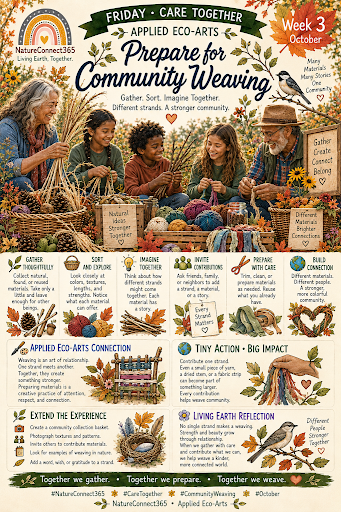
#NatureConnect365 #AppliedEcoArts #CommunityWeaving #CareTogether #NatureWeaving #CollaborativeArt #EcoArt #NatureArt #AutumnActivities #NaturalMaterials #CreativeCommunity #NatureConnection #LivingEarthTogether