Invitation
Step outside and discover the colors of November.
Look for colors that catch your attention—and colors you might usually walk past.
Rust. Amber. Gold. Brown. Gray. Evergreen. Cream. Deep red. Blue sky. Dark earth.
Walk slowly enough for the season to show you its palette.
👣 Walk
Follow the Colors of November
Choose a safe outdoor place to explore: a backyard, sidewalk, schoolyard, garden, park, woodland path, neighborhood, or another familiar place.
Before you begin walking, pause.
Look around without searching for anything in particular.
What color attracts your attention first?
Begin your Color Walk.
1 · Find
Walk until a color catches your attention.
It might appear in a leaf, tree trunk, stone, seedpod, berry, patch of moss, cloud, garden plant, building, or something unexpected.
Pause when you find it.
2 · Look
Move closer if it is safe to do so.
Notice whether the color is bright, faded, light, dark, warm, cool, smooth, speckled, striped, or patterned.
Is it one color—or many colors together?
3 · Follow
Look around for another place where that color appears.
Can you follow it through the landscape?
Perhaps brown travels from fallen leaves to tree bark to soil.
Perhaps green moves from moss to evergreen needles.
Perhaps gold appears in grass, leaves, seeds, or sunlight.
4 · Discover
Choose another color and continue walking.
Notice colors you expected to find and colors that surprise you.
Try looking high, low, near, and far.
5 · Pause
Near the end of your walk, stop somewhere that feels comfortable.
Look back across the place you explored.
Which colors now seem especially noticeable?
Which colors might you have missed if you had walked quickly?
🌿 Breathe
Color Pause Breathing
Choose one color that attracts you.
You can look toward it, hold a safely gathered natural object, or simply remember the color.
Breathe in…
Let your eyes rest gently on the color.
Breathe out…
Notice where else it appears.
Breathe in…
Notice light, shade, texture, and pattern.
Breathe out…
Soften your gaze and notice the larger landscape again.
Repeat three to five times, or for as long as feels comfortable.
There is no need to change or control your breath.
Simply notice breathing while you spend a little more time with the colors around you.
👀 Notice
Can you notice…
🍁 rust, amber, gold, red, or brown leaves
🌲 evergreen among bare or changing branches
🪵 different shades within tree bark
🌰 seeds, nuts, cones, and seedpods
🌱 green moss or low-growing plants
🪨 gray, tan, white, or patterned stones
🍂 colors changing within a single fallen leaf
☁️ November sky colors
☀️ how sunlight makes colors appear brighter
🌥️ how shade changes the colors you see
💧 colors reflected in puddles, ponds, or other water
🐦 colors carried by birds or other animals
🏡 colors from the human-made world mixed into the landscape
👣 how the colors change as you move from one place to another
🎨 colors you expected to see
✨ one color that surprises you
A November landscape that first appears brown or gray may hold dozens of colors when we slow down and look closely.
💭 Wonder
Which color attracted you first?
Which color did you find most often?
Which color was hardest to find?
Did you discover a color you did not expect?
How many shades of one color can you notice?
Where did you find the brightest color?
How does sunlight change the colors around you?
Do colors look different from far away and close up?
Which colors seem to belong especially to November?
How are November’s colors different from summer’s colors?
Why do some plants remain green while others lose their leaves?
What colors might disappear as winter approaches?
What colors might remain?
How did looking for color change the way you experienced your walk?
🌎 Connect
Autumn does not suddenly become colorless when the brightest leaves begin to fall.
As November moves toward winter, the landscape reveals a different palette.
Many deciduous trees have released or are releasing their leaves. Seed heads, grasses, bark, branches, soil, stones, mosses, evergreens, berries, and fallen leaves become easier to notice.
Color also changes with light.
Morning sun, afternoon shadows, cloudy skies, wet leaves, frost, and reflections can make the same place look different from one day—or even one moment—to the next.
A Color Walk helps us experience seasonal change through careful observation.
Instead of deciding beforehand what November should look like, we allow the place itself to show us what is present.
When we slow down and follow what attracts our attention, familiar surroundings can become newly visible.
Color becomes a pathway into curiosity, relationship, and belonging.
🌈 Try Another Way
Try…
choosing one color and following it throughout your walk
searching for five different shades of brown
finding a natural object for every color of the rainbow that is actually present
photographing colors instead of collecting objects
creating a November color palette from photographs
carrying colored paper or paint samples and finding close matches
sketching the colors you discover
making small color swatches in a nature journal
naming your own November colors
walking the same route on a sunny and cloudy day
comparing morning and afternoon colors
looking only for colors above eye level
looking only for colors close to the ground
taking a silent Color Walk
walking with a partner and noticing whether the same colors attract each of you
creating a collaborative color list with a group
exploring from a seated position
looking through a window when going outdoors is not accessible
revisiting the same place later in November to see what has changed
There is no correct number of colors to find.
Follow what attracts your attention.
❤️ Care for Yourself and Others
Choose a walking place appropriate for your body, mobility, weather conditions, and comfort.
Check paths for uneven ground, wet leaves, ice, roots, traffic, or other hazards.
Walk, roll, sit, pause, or observe from one place.
Stay on established paths where required.
Children should explore with appropriate adult supervision.
Wear clothing and footwear suitable for November weather.
Be aware that daylight becomes shorter during late autumn and plan your walk accordingly.
Look without touching whenever you are unsure whether a plant, berry, mushroom, or other natural object is safe to handle.
Gather only abundant, fallen materials where gathering is permitted.
Leave living plants, attached bark, wildlife food, nests, shelters, and habitats undisturbed.
Return natural objects to the place when appropriate.
Pause or head indoors whenever you become cold, tired, uncomfortable, or ready to stop.
A Color Walk can be five minutes or an afternoon.
Let your body, curiosity, and surroundings help determine the pace.
📸 Share
Photograph your favorite November color.
Create a collage of the colors you discovered.
Draw a simple November color palette.
Share the most surprising color you found.
Compare color discoveries with another person.
Create names for unusual colors such as wet-bark brown, November-sky blue, moss green, or fallen-leaf gold.
Make a group color chart from everyone’s discoveries.
Choose one photograph that tells the story of your walk.
Revisit your Color Walk later in the month and photograph the same place again.
Share one color that helped you see a familiar place differently.
📝 Nature Note
The first color that attracted me was…
A color that surprised me was…
I found many shades of…
When I slowed down, I noticed…
November looks like…
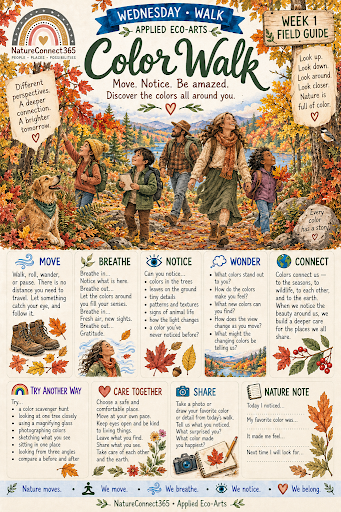
#NatureConnect365 #ColorWalk #WednesdayWalk #AppliedEcoArts #NovemberNature #AutumnColors #NatureWalk #NoticeNature #NatureObservation #NatureConnection #OutdoorLearning #NatureBasedLearning #SeasonalLearning #MindfulNature #EveryBodyEveryDay #StartWhereYouAre #WalkWithTheSeason