Invitation
Walk a little.
Pause a little longer.
Look again.
Choose a familiar outdoor place and explore it with unhurried attention.
You do not need to travel far or find anything extraordinary.
A patch of bark.
A curled leaf.
A tiny seed.
A shadow.
A feather.
A crack in a stone.
What becomes visible when you give something more time?
👣 Walk
Walk · Pause · Look Again
Choose a safe outdoor place to explore: a backyard, sidewalk, schoolyard, garden, park, woodland path, neighborhood, or another familiar place.
There is no distance you need to travel.
Today, the invitation is to spend more time noticing.
1 · Arrive
Before beginning your walk, pause where you are.
Look around.
Notice what immediately attracts your attention.
You do not need to name it or understand why.
Simply notice.
2 · Wander
Begin moving through the space at a pace that works for you.
Walk, roll, pause, sit, or explore from one place.
Allow your attention to wander too.
When something catches your eye, stop.
3 · Look
Spend a little time with what you found.
Notice its shape.
Its color.
Its edges.
Its surface.
Its relationship to what surrounds it.
Look from more than one angle if you can do so safely.
4 · Look Again
Before moving on, ask:
What did I miss the first time?
Perhaps you notice a tiny hole in a leaf.
A line traveling through bark.
Several colors inside something that first looked brown.
A seed tucked beneath a stem.
A strand of spider silk catching the light.
Look again.
5 · Continue
Move when you feel ready.
You might travel several steps or only a few feet before something else attracts you.
There is no number of discoveries to make.
Let attention—not distance—guide the walk.
6 · Remember
Near the end of your walk, pause again.
Think about one thing you noticed only because you stayed with it.
What became visible with time?
🌿 Breathe
Pause-and-Notice Breathing
Find a comfortable place to pause.
You might sit, stand, lean, or remain wherever you are.
Let your gaze rest gently on something nearby.
Breathe in…
Notice one thing you can see.
Breathe out…
Allow yourself to stay.
Breathe in…
Notice one more detail.
Breathe out…
Soften your gaze and notice what surrounds it.
Continue for several breaths if you wish.
There is no need to deepen, slow, or change your breathing.
Simply allow breath and attention to accompany one another.
👀 Notice
Can you notice…
🍂 the curled edge of a fallen leaf
🌳 lines, cracks, ridges, or patches on bark
🌰 seeds hidden among leaves or grasses
🌱 moss, lichen, or tiny plants growing close to the ground
🪨 patterns, grains, speckles, or tiny openings in stone
🕸️ a strand of spider silk catching the light
🪶 a feather or other sign that an animal has passed through
🐾 tracks, holes, pathways, nests, or other signs of animal activity
💧 drops of water resting on a surface
☀️ sunlight illuminating one small part of the landscape
🌥️ shadows changing shapes
🌬️ one small thing moving in the breeze
👂 a sound you did not notice when you first arrived
👃 the scent of leaves, soil, bark, rain, or cool air
✋ differences between smooth, rough, soft, brittle, or damp surfaces when touching is safe
🔍 something tiny beside something much larger
🍁 something changing, fading, drying, opening, closing, or decomposing
✨ a detail that becomes visible only after you stay awhile
Sometimes what appears ordinary from a distance becomes extraordinary when we give it our attention.
💭 Wonder
What attracted your attention first?
What made you decide to pause?
What did you notice after looking for a few moments?
What did you discover when you looked again?
Which details were easiest to see?
Which details took more time?
What changed when you moved closer?
What changed when you stepped farther away?
Did listening help you notice something you could not see?
What signs of seasonal change did you discover?
What evidence of other living beings did you find?
How much can you discover in one very small place?
Does a familiar place feel different when you give it more attention?
What might you notice if you returned tomorrow?
What becomes possible when we do not hurry past?
🌎 Connect
Nature is filled with relationships and details that can be difficult to notice when we move quickly.
A tree trunk may first appear to be one shade of brown. When we stay with it, we might discover ridges, cracks, mosses, lichens, holes, scars, shadows, insects, or subtle changes in color.
A patch of fallen leaves may reveal seeds, fungi, decomposing plant material, animal pathways, moisture, and tiny sheltered spaces.
Late autumn can make some of these details especially visible.
As leaves fall and vegetation changes, branches, bark, seed heads, nests, stones, soil, and other structures that were hidden during the growing season may become easier to see.
Slow looking does not require us to physically move slowly.
It asks us to give attention time.
When we pause, return our attention, and look again, we begin to experience a place not simply as scenery but as a community of living and changing relationships.
The more carefully we notice a place, the more opportunities we have to know it, care for it, and recognize that we belong within it too.
🌈 Try Another Way
Try…
choosing one tree and spending the whole activity near it
exploring one square foot of ground
looking at something from three different angles
looking high, middle, and low
using a magnifying glass
photographing one object from close, middle, and far distances
drawing something before and after looking closely
making a list of ten details within one small area
listening with your eyes closed or gaze softened when it is safe
taking a silent walk
walking with a partner and comparing what attracts each person’s attention
letting another person choose your next place to pause
looking for signs that an animal has visited
searching for something changing or decomposing
returning to something you noticed during Week 1’s Color Walk
observing entirely from a seated position
looking through a window, doorway, or sheltered outdoor space
revisiting the same tiny place later in the season
Slow looking can happen anywhere.
Sometimes one leaf, one tree, or one patch of earth is enough.
❤️ Care for Yourself and Others
Choose a place appropriate for your body, mobility, weather conditions, and comfort.
Move at the pace that supports you.
“Slow looking” does not mean you must walk slowly.
You may walk, roll, sit, stand, pause, or remain in one comfortable place.
Check paths for wet leaves, roots, uneven surfaces, traffic, ice, or other hazards.
Stay on established paths where required.
Children should explore with appropriate adult supervision.
Wear clothing and footwear suitable for November weather.
Remember that daylight becomes shorter during late autumn.
Look closely without disturbing what you find.
Avoid turning over logs, rocks, bark, nests, or other materials that may provide shelter unless you are participating in an appropriately supervised activity.
Do not touch unfamiliar plants, fungi, berries, insects, or wildlife.
Give animals space and observe from a respectful distance.
Leave living plants and habitats undisturbed.
Use magnifying tools carefully and never focus sunlight through a magnifying lens.
Pause, rest, warm up, or return indoors whenever you wish.
Attention does not depend on distance, speed, or physical movement.
Start where you are.
📸 Share
Photograph one tiny detail you almost missed.
Create a close-up photograph and invite someone to guess what it is.
Draw something you discovered during your walk.
Make a “first look / second look” sketch.
Write five details about one natural object.
Share the discovery that surprised you most.
Compare observations with another person.
Create a group collection of photographs called Look Again.
Record one outdoor sound you noticed after becoming quiet.
Return to your Week 1 Color Walk photographs and look for details you had not noticed before.
Teach someone else the practice:
Pause. Look. Look again.
📝 Nature Note
Something that attracted my attention was…
When I looked again, I discovered…
A tiny detail I almost missed was…
Giving attention more time helped me notice…
I wonder…
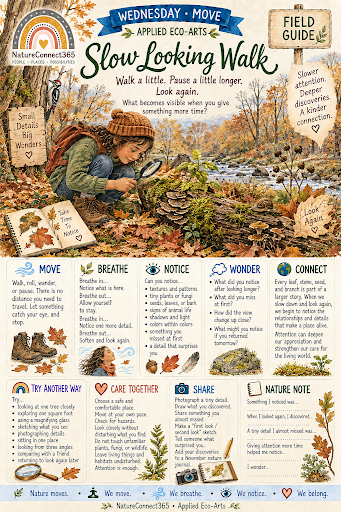
#NatureConnect365 #SlowLookingWalk #WednesdayWalk #AppliedEcoArts #SlowLooking #NoticeNature #NatureObservation #NatureWalk #MindfulNature #NatureConnection #OutdoorLearning #NatureBasedLearning #SeasonalLearning #NovemberNature #PlaceBasedLearning #EveryBodyEveryDay #StartWhereYouAre #WalkWithTheSeason