🌎 Invitation
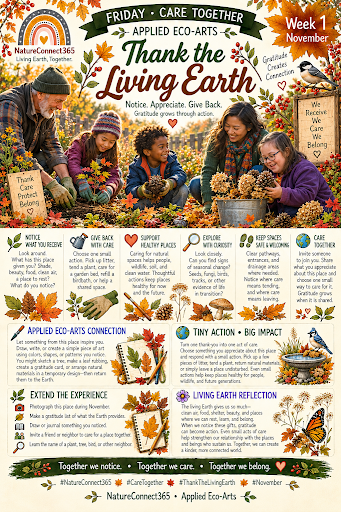
November invites us to notice how much we have received.
Throughout the year, the living Earth has been quietly offering gifts.
Trees have given shade, shelter, oxygen, seeds, and changing color. Soil has held roots and transformed fallen materials. Rain has replenished gardens and waterways. Flowers have fed pollinators. Plants have offered food. Birds, insects, fungi, animals, wind, sunlight, and countless other relationships have helped shape the places where we live.
Some of these gifts are easy to see.
Others happen almost unnoticed.
Today, spend time with a place that has given something to you.
It might be a garden, tree, woodland edge, park, shoreline, neighborhood green space, schoolyard, community garden, or simply a small patch of Earth you pass regularly.
Begin by receiving.
Look. Listen. Remember. Notice.
Then ask:
How might I offer something in return?
Let gratitude become a small act of care.
🌿 What You’ll Need
A familiar outdoor place
Comfortable clothing for being outdoors
Gloves or simple care tools, if appropriate
A reusable bag or container if collecting litter
Paper, journal, or small card, if desired
Pencil, colored pencils, or other simple art materials
Natural materials already fallen to the ground, if appropriate
A few unhurried minutes
Curiosity about what this place has given you
A willingness to offer care in return
💚 Care Together
Begin by entering your chosen place slowly.
Before doing anything, spend a few moments simply noticing.
Look around you.
What is growing here?
What has gone to seed?
What has fallen?
What is still green?
Where is water held?
Where might an animal find food or shelter?
What has changed since you last visited?
Then think about what this place has offered throughout the year.
You might remember:
Shade beneath a tree.
Flowers visited by bees and butterflies.
A garden that produced food.
A path where you walked.
A tree where birds gathered.
A patch of grass where children played.
A quiet place where you rested.
Rain soaking into dry soil.
Leaves changing through the seasons.
A view that helped you pause.
A place where you felt curious, peaceful, connected, or at home.
Choose one small way to respond.
You might:
Pick up litter.
Gently tend a garden bed.
Return a misplaced natural object to the landscape.
Care for a plant.
Clear something that is blocking a safe pathway.
Refill an appropriate water source.
Leave seed heads, leaves, or sheltered areas undisturbed.
Sit quietly and offer words of thanks.
Draw or write about something you appreciate.
Share the place with someone else.
Simply notice carefully without changing anything.
Not every place needs us to do something.
Sometimes gratitude asks us to act.
Sometimes gratitude asks us to protect.
Sometimes gratitude asks us to leave a place undisturbed.
Let the place help you decide.
👀 Notice
As you spend time with the living Earth, ask yourself:
What has this place given throughout the year?
What is still being offered now?
Which gifts are easy to notice?
Which might usually go unseen?
What signs of other lives can I find?
What relationships seem to be happening here?
Is there something that needs care?
Is there something that needs protection from unnecessary disturbance?
What happens when I think of myself as receiving from this place?
What kind of response feels appropriate?
Listen, too.
Notice wind through bare or thinning branches, leaves moving across the ground, birds calling, water moving, footsteps, insects, distant human sounds, or November quiet.
Allow gratitude to begin with attention.
🎨 Applied Eco-Arts Connection
Gratitude can become a creative practice of noticing and responding.
Choose one natural being, element, pattern, or relationship that attracts your attention.
A tree.
A seed.
A patch of moss.
A bird.
A fallen leaf.
A stone warmed by sunlight.
Clouds moving overhead.
The shape of branches against the sky.
Spend a few moments observing it closely.
Then create a simple gratitude response.
You might make a small sketch, write a few words, trace a remembered shape, create a temporary arrangement from already-fallen materials, or compose a one-line thank-you:
Thank you, tree, for…
Thank you, soil, for…
Thank you, rain, for…
Thank you, this place, for…
Your response does not need to become something you keep.
If you create with natural materials, return them to the place when you are finished.
Applied Eco-Arts invites creativity to become part of relationship.
We notice.
We respond.
We allow what we create to deepen our attention to the living world.
🌎 Tiny Action • Big Impact
Turn one thank-you into one act of care.
Choose something you appreciate about the living Earth and connect that gratitude with a small response.
If you are grateful for a neighborhood tree, care gently for the space around it.
If you appreciate a local park, pick up a few pieces of litter.
If birds bring you joy, learn what habitat they need as the season changes.
If you are thankful for a garden, return organic material to the soil where appropriate.
If a natural place gives you somewhere to rest, help leave it cared for when you go.
The action does not need to be large.
The important shift is from:
I am thankful for this.
to:
Because I am thankful, I will care for this relationship.
Stewardship can begin there.
Gratitude received.
Gratitude expressed.
Gratitude returned through care.
🌱 Extend the Experience
Visit the same place several times during November and notice what continues to change.
Create a Living Earth Gratitude List by adding one observation each day.
Draw something from the landscape that you usually overlook.
Write a short thank-you note to a tree, garden, waterway, animal, or place.
Invite someone else to share one thing they appreciate about the living Earth.
Photograph one ordinary natural gift each day for a week.
Choose one small stewardship action inspired by something you are grateful for.
Make a temporary gratitude circle or spiral from already-fallen natural materials, then return them to the landscape.
Notice the people whose care also supports the places you enjoy.
Learn the name of one plant, bird, tree, insect, fungus, or other neighbor you encounter.
Begin a family, classroom, or community Living Earth Gratitude Jar with observations from the season.
Return in winter and notice what the same place continues to offer.
🌼 Living Earth Reflection
Gratitude begins with recognizing that we are continually receiving.
Sunlight reaches leaves.
Rain enters soil.
Roots hold ground.
Flowers feed insects.
Plants become food.
Trees offer shelter.
Fallen materials return to Earth.
And within these relationships, our own lives are held.
The living Earth is not only a beautiful background to our days. We participate in systems of exchange, dependence, nourishment, shelter, transformation, and renewal.
When we begin to notice what we receive, gratitude can become more than a feeling.
It can become reciprocity.
We can respond to what sustains us with attention.
With restraint.
With protection.
With creativity.
With stewardship.
With care.
We do not need to repay every gift.
We can simply learn to live as though we recognize that gifts are being given.
#ShareGratitude #GratitudeLight #NatureConnect365 #AppliedEcoArts #AutumnGratitude #NatureGratitude #GratitudePractice #NatureConnection #SeasonalLiving #MindfulNature #CommunityCare #Belonging #GratitudeWithKids