Discovering Seed Coats, Fruits, Pods, and the Future Held Within
Inside an acorn, sunflower seed, milkweed pod, berry, pinecone, or dried bean is the possibility of another plant.
Seeds may be tiny, but they carry living beginnings.
Before a new plant can grow, its seed may need to survive drying, cold, changing weather, hungry animals, or months of waiting. Plants have developed remarkable ways to surround, hold, cover, and protect their seeds until conditions support what comes next.
Look closely and discover how plants care for future life.
🌿 Explore
Take a seed walk through a garden, meadow, woodland, neighborhood, or other outdoor place.
Look for seeds and the structures that hold them:
acorns and other nuts
berries and fruits
pinecones
dried flower heads
seed pods
grasses
winged seeds
burrs
capsules
husks
shells
seeds tucked inside dried stems
Observe seeds where they are growing before collecting anything.
Notice whether seeds are:
enclosed
exposed
hanging
clustered
tucked inside a fruit
protected by a hard shell
held inside a cone
enclosed in a dry pod
surrounded by fluff
attached to hooks or bristles
waiting on a dried flower head
Gather only abundant, naturally fallen materials where collection is permitted.
How many different ways can you find plants holding their seeds?
🔍 Observe
Choose several different seeds or seed-bearing structures and look closely.
Can you notice…
hard or soft coverings
smooth, rough, fuzzy, or prickly surfaces
thick shells
thin papery coverings
seams where pods may open
overlapping scales on cones
seeds hidden inside fruits
seeds arranged in repeating patterns
wings, hairs, hooks, or fluff
different seed sizes from different plants
many seeds produced by one plant
one large seed protected inside a fruit or shell
signs that an animal has opened or eaten a seed
empty pods or cones where seeds have already dispersed
Gently compare their shapes and textures.
What might each structure help the seed do?
💡 Discover
A seed contains the beginning of a new plant.
Inside many seeds is a tiny embryo that can develop into a seedling. Seeds also contain stored nutrients that help support early growth before the young plant can make enough of its own food.
Around the seed is a protective seed coat.
Seed coats vary greatly. Some are thin and papery. Others are thick, hard, or resistant to water. These coverings can help protect the embryo from drying, physical damage, and other environmental conditions.
Plants may add additional layers of protection.
Seeds can develop inside:
fruits
berries
pods
cones
capsules
husks
shells
Protection does not mean that a seed must remain sealed forever.
Many protective structures also help determine when and how seeds are released.
A dry pod may split open. A cone may release its seeds when conditions change. A fruit may be eaten by an animal. A nut may be carried and buried.
The structure that protects a seed can also become part of its journey.
💭 Wonder
Why do seeds need protection?
Why are some seed coats hard while others are thin?
Why do some plants surround seeds with juicy fruits?
Why do other plants make dry pods or cones?
Why might one plant produce thousands of tiny seeds while another produces fewer large ones?
How does a seed know when to begin growing?
Can a seed remain alive without growing?
How might a hard seed coat help during winter?
Why do squirrels bury nuts?
What happens when an animal eats a fruit containing seeds?
Why do some seed pods open suddenly?
How do seeds travel away from their parent plants?
What might happen if every seed began growing immediately?
A seed is both a living beginning and a traveler waiting for the right conditions.
🌎 Connect
Seed protection is connected to seed dispersal.
Plants cannot walk to a new growing place, but their seeds can move.
Some travel by wind. Wings, hairs, or silky fibers can help them float or spin through the air.
Some travel with animals. Hooks and burrs may cling to fur, feathers, or clothing. Fruits may attract animals that eat them and later deposit seeds somewhere else. Squirrels and other animals may carry and cache nuts, sometimes leaving some behind to germinate.
Some seeds travel by water, while others are released when pods dry, twist, split, or burst.
Seeds that remain near the parent plant may become food for birds, mammals, insects, and other organisms.
A protected seed therefore belongs to a much larger web of relationships involving plants, animals, weather, soil, water, and season.
🌈 Explore More
Create a Seed Protection Investigation.
Find three to five different seeds or seed-bearing structures that can be ethically collected, or observe and photograph them where they grow.
Create a simple investigation chart for each one:
Seed:
What plant might it come from?
Protection:
Is it protected by a coat, shell, pod, cone, fruit, husk, or another structure?
Texture:
Is it hard, soft, smooth, rough, fuzzy, papery, prickly, or woody?
Release:
How might the seed get out?
Travel:
Could it move by wind, water, animals, gravity, or another method?
Then create an Applied Eco-Arts study.
Draw the seed inside its protective structure.
Make a clay model showing the layers around a seed.
Create seed and pod rubbings.
Use repeated seed shapes to make a pattern.
Photograph seed structures without removing them.
Or create a Seed Journey Map showing one seed moving from its parent plant toward a possible new growing place.
Notice the relationship between protection and movement.
❤️ Tiny Action
Help seeds complete their seasonal work.
Where appropriate:
leave some dried flower heads standing through winter
allow native plants to hold their seeds naturally
leave some berries and fruits available for wildlife
avoid collecting every acorn, cone, or interesting seed
gather only what you need for art or investigation
return unused natural materials outdoors
learn which local plants provide winter food
save seeds from appropriate garden plants for future growing
avoid spreading seeds from invasive plants
choose native plants when adding habitat to gardens and community spaces
A seed that looks small or ordinary to us may be food, shelter, future habitat, or the beginning of another generation.
📸 Share
Create a collection of seed photographs rather than collecting the seeds themselves.
Compare a pod, cone, fruit, and nut.
Draw a seed and the protective structure surrounding it.
Invite someone to become a seed detective with you.
Share:
the smallest seed you discovered
the strongest seed covering you found
the most surprising seed container
one seed designed to travel
an animal connected with a seed you observed
one way a plant protects future life
one way you can help seeds remain available for wildlife
📝 Nature Note
Today I discovered a seed protected by…
Its covering felt…
I think this protection might help the seed…
This seed may travel by…
One animal that might interact with this seed is…
Inside this small seed is the possibility of…
One question I still have about seeds is…
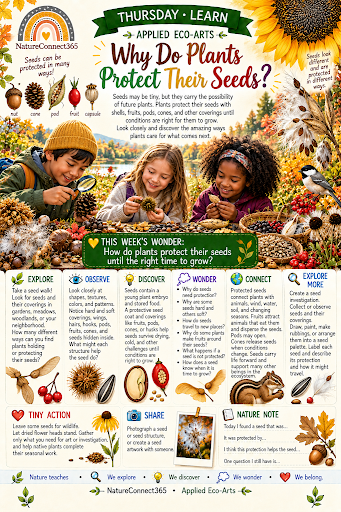
#NatureConnect365 #AppliedEcoArts #ThursdayLearn #Seeds #SeedScience #SeedDispersal #PlantLifeCycle #NativePlants #WinterHabitat #OutdoorLearning #NatureStudy #NatureConnection #SeasonalLearning #Wonder