🌎 Invitation
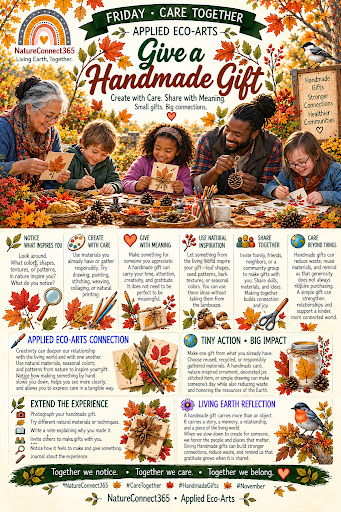
A gift can begin long before it is given.
It begins when we think of someone.
We remember something they love. We notice what might bring them comfort or joy. We choose materials. We spend time making. Our hands slowly turn ordinary things into an expression of relationship.
A meaningful gift does not have to be purchased.
It might begin with a scrap of fabric, a piece of reused paper, leftover yarn, a fallen leaf, a drawing, a photograph, a favorite recipe, or materials already waiting in a drawer or basket.
Today, make something simple for another person.
Let the gift carry more than the object itself.
Let it carry your attention.
Your time.
Your creativity.
Your gratitude.
Before beginning, pause and ask:
What would I like this person to feel when they receive what I make?
🌿 What You’ll Need
Choose materials based on what you would like to create.
You might gather:
Recycled or reused paper and cardboard
Fabric scraps, felt, ribbon, yarn, or thread
Pencils, crayons, markers, paints, or ink
Scissors and glue
A needle and thread, with appropriate supervision
Pressed or already-fallen leaves and flowers
Fallen twigs, seed pods, or other responsibly gathered natural materials
Reused jars, boxes, envelopes, or containers
Photographs or copied images
A favorite recipe, poem, memory, or story
Simple wrapping materials you already have
Time to make slowly and thoughtfully
Someone you would like to thank, encourage, celebrate, or remember
You do not need many materials.
Begin by looking at what you already have.
💚 Care Together
Think of someone you would like to receive your handmade gift.
It might be a family member.
A friend.
A neighbor.
A teacher.
A caregiver.
A community volunteer.
Someone who has helped you.
Someone who might appreciate being remembered.
Someone you simply want to thank.
Then look through the materials available to you.
Instead of beginning by asking, What should I buy?, try asking:
What can I make from what is already here?
You might create:
A hand-drawn gratitude card.
A pressed-leaf bookmark.
A small stitched ornament.
A nature-inspired collage.
A painted or decorated stone.
A simple weaving from leftover yarn.
A handmade recipe card.
A drawing of a favorite shared place.
A small bundle of dried garden herbs.
A decorated reused jar filled with gratitude notes.
A nature print or rubbing.
A tiny garland made from reused paper or fabric.
A photograph paired with a handwritten memory.
A simple repaired or renewed object that can be used again.
Choose something that feels manageable.
The gift does not need to be perfect.
It does not need to look like something from a store.
Allow your hands, materials, memories, and relationship with the recipient to guide what emerges.
👀 Notice
As you make, slow down enough to notice the experience.
Ask yourself:
Why did I choose this person?
What do I appreciate about them?
Why did I choose these materials?
Where did these materials come from?
Can anything be reused instead of discarded?
What textures, colors, shapes, or patterns attract me?
Does something in nature inspire the gift?
What memories arise while I work?
How does making for someone feel different from making only for myself?
What part of the gift carries the most meaning?
Notice your hands.
Cutting.
Folding.
Stitching.
Drawing.
Wrapping.
Writing.
Tying.
Arranging.
Making can become its own form of attention.
🎨 Applied Eco-Arts Connection
Applied Eco-Arts invites us to explore how creativity can deepen relationship.
For this activity, let something from the living world inspire one part of your handmade gift.
You might notice:
The branching pattern of a tree.
The veins of a leaf.
The spiral of a seed head.
The colors of November grasses.
The shape of a stone.
The rhythm of migrating birds.
The texture of bark.
The silhouette of bare branches.
The repeating pattern of seeds.
Rather than needing to take these things from the landscape, allow them to become inspiration.
Draw the branching pattern.
Stitch the shape of a leaf.
Paint November colors.
Print a repeating seed pattern.
Write a few words inspired by a familiar place.
Create a simple symbol representing something you and the recipient share.
Nature can become part of the creative relationship without always becoming material for the object.
Applied Eco-Arts asks us to notice that inspiration itself is a gift.
We receive.
We imagine.
We create.
We share.
🌎 Tiny Action • Big Impact
Make one gift from what you already have.
Before purchasing new materials, look around.
What is waiting to be used?
A scrap of beautiful paper.
Leftover yarn.
Fabric from another project.
An empty jar.
A cardboard box.
An old greeting card.
A ribbon saved from another gift.
A photograph.
A drawing.
A pressed leaf.
A story.
A skill.
A little time.
Using what we already have can reduce waste while inviting creativity.
It also changes the question from:
What can I get?
to:
What can I create and share?
The smallest handmade gift can carry something that cannot be purchased:
your attention.
🌱 Extend the Experience
Make a second gift for someone who may not expect one.
Create handmade gratitude cards for neighbors, teachers, caregivers, volunteers, or community helpers.
Invite family members or friends to make gifts together.
Hold a no-new-materials making afternoon using only supplies already available.
Teach someone a simple creative skill you know.
Ask an older family or community member about something they once made by hand.
Make reusable gift tags from old cards, paper, or fabric.
Wrap your gift with reused paper, fabric, a saved bag, or another material already available.
Include a handwritten note explaining why you made the gift.
Create something inspired by a place you and the recipient share.
Repair or refresh an existing object and offer it a longer life.
Share a recipe, poem, photograph, story, or memory as a gift.
Begin a small collection of reusable creative materials for future gift-making.
Notice which materials from everyday life might become art supplies instead of waste.
🌼 Living Earth Reflection
Making by hand asks something different of us.
It asks us to slow down.
To notice what we already have.
To remember someone.
To imagine what might delight them.
To work with the possibilities and limitations of real materials.
A scrap becomes part of a collage.
A piece of yarn becomes a loop, knot, or stitch.
A remembered landscape becomes a drawing.
A reused jar holds words of gratitude.
Something ordinary becomes meaningful because relationship has entered the making.
The living Earth creates this way, too.
Nothing exists entirely on its own.
Leaves become soil.
Seeds become plants.
Plants become food and shelter.
Old materials become nourishment for new life.
Transformation happens through relationship.
Handmade giving can remind us that abundance does not always mean having more.
Sometimes abundance means seeing more possibility in what is already here.
A material.
A memory.
A skill.
A pair of hands.
A little time.
Someone we care about.
And something we would like them to know.
#ShareGratitude #GratitudeLight #NatureConnect365 #AppliedEcoArts #AutumnGratitude #NatureGratitude #GratitudePractice #NatureConnection #SeasonalLiving #MindfulNature #CommunityCare #Belonging #GratitudeWithKids