🩵 Pollination Field Journal
Wonder Through Observation Relationship Through Noticing Science Through Curiosity
Applied Eco-Arts Learning Series | Summer Nature Journaling Practice
🌞 Overview
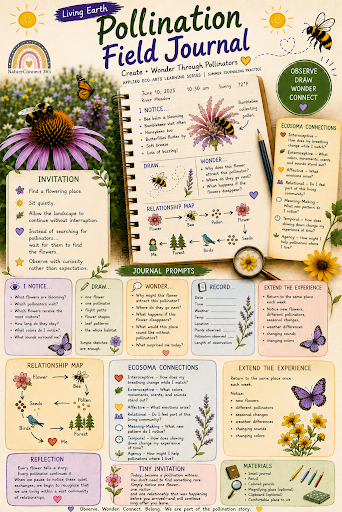
Pollination Field Journal invites participants to become quiet observers of one of Earth’s most important relationships.
Rather than collecting flowers or insects, participants collect moments of attention.
Using a simple handmade journal, participants spend time watching bees, butterflies, moths, flies, beetles, hummingbirds, and other pollinators as they move through gardens, parks, meadows, or even a single flowering plant.
The practice begins with slowing down, finding a place to sit, and allowing the landscape to continue without interruption. Participants then observe, sketch, write, wonder, map relationships, and return to the same place over time. Through repeated visits, familiar flowers become neighbors, pollinators become recognizable individuals, and patterns begin to emerge.
Each page becomes a living record of relationship—between flower and pollinator, movement and stillness, curiosity and patience, observation and imagination.
As participants notice colors, flight patterns, favorite flowers, weather, sounds, and seasonal changes, they begin seeing pollination not as an isolated event but as an ongoing conversation that supports entire ecosystems. This reflects Applied Eco-Arts’ emphasis on learning through reciprocal relationship with living systems rather than detached observation.
This practice supports scientific inquiry, sensory awareness, creative expression, ecological literacy, reflective thinking, seasonal noticing, environmental stewardship, and a growing sense of belonging with place.
🍁 Learning Focus
Participants are invited to:
Observe pollinators with patience and curiosity.
Notice relationships between insects, flowers, weather, and habitat.
Practice careful scientific observation alongside creative expression.
Strengthen attention through drawing, writing, mapping, and storytelling.
Experience wonder through repeated visits to the same place.
Develop ecological awareness through seasonal observation.
Build belonging with local landscapes.
Discover how small observations reveal larger ecological patterns.
🌿 Six Pathways
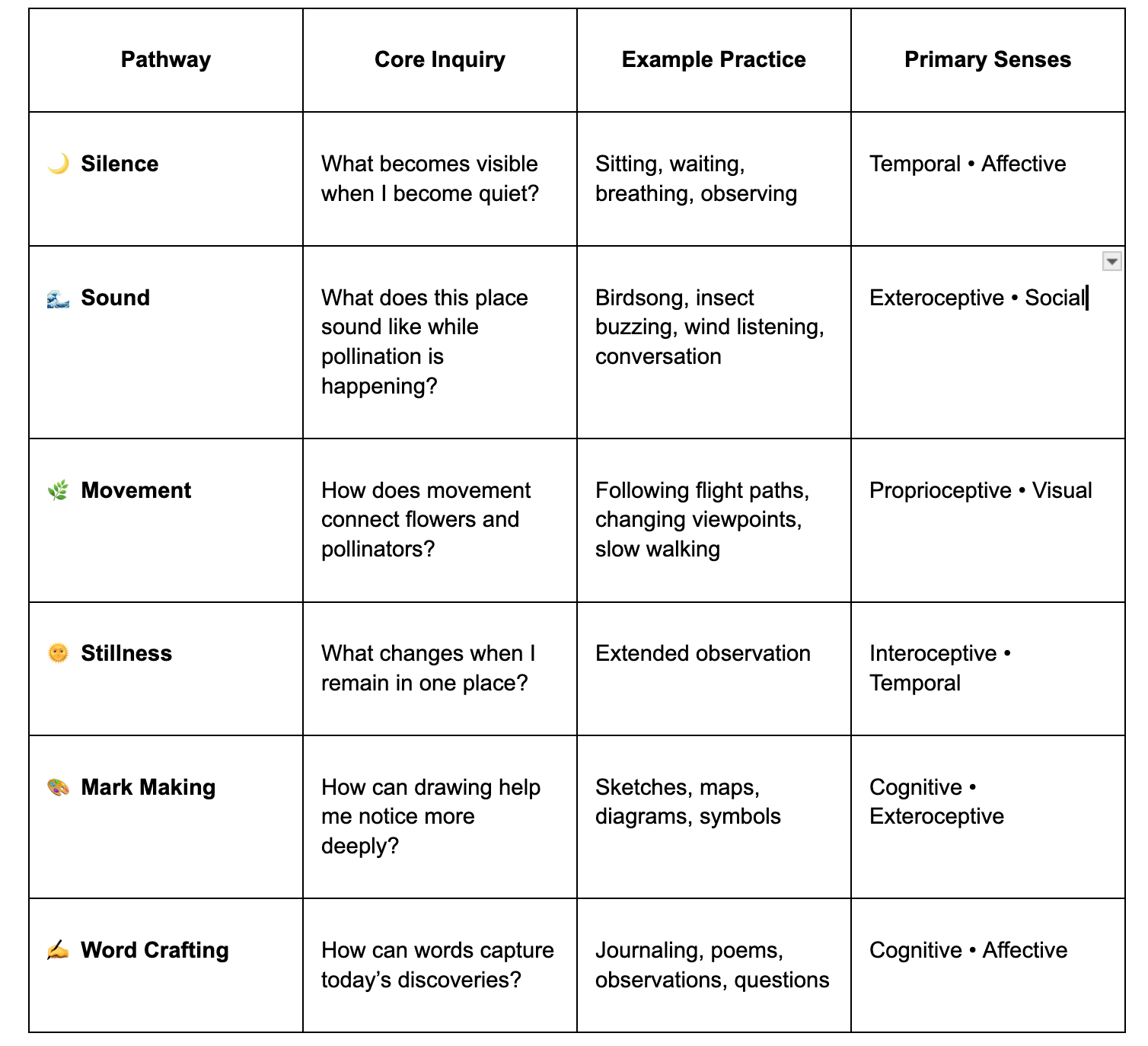
🧭 Materials
Core Materials
Small notebook or handmade field journal
Pencil
Colored pencils or watercolor (optional)
Optional Materials
Clipboard
Magnifying glass
Binoculars
Plant identification guide
Pollinator field guide
Comfortable blanket or sit pad
☀️ Field Practice
1. Arrive
Find a flowering place.
Sit quietly.
Allow the landscape to continue without interruption.
Rather than searching for pollinators…
Wait for them to find the flowers.
Observe with curiosity rather than expectation.
2. Hold the Field
Notice:
your breathing
the quality of light
today’s weather
surrounding sounds
movement in the landscape
Become part of the place before beginning to record.
3. Follow Attraction
Allow curiosity to guide your attention.
Perhaps you notice:
one flower
one bee
one butterfly
one movement
one sound
one color
one question
Follow that attraction.
4. Journal
👀 I Notice…
What flowers are blooming?
Which pollinators visit?
Which flowers receive the most visitors?
How long do they stay?
What colors do I notice?
What sounds surround me?
✏️ Draw
Sketch:
one flower
one pollinator
flight paths
flower shapes
leaf patterns
the whole habitat
Simple sketches are enough.
💭 Wonder
Why might this flower attract this pollinator?
Where do they go next?
What happens if this flower disappears?
What would this place sound like without pollinators?
What surprised me today?
📝 Record
Date
Time
Weather
Temperature (optional)
Location
Plants observed
Pollinators observed
Length of observation
🌼 Relationship Map
Draw simple arrows showing connections.
Flower → Bee
Bee → Pollen
Pollen → Flower
Flower → Seeds
Seeds → Birds
Birds → Forest
Forest → Me
5. Pause
Before leaving, sit quietly once more.
Notice:
What changed?
What surprised you?
What feels more familiar?
What relationship became visible?
🌎 EcoSoma Connections
While observing, notice which EcoSoma Sense families become active.
🫀 Interoceptive — How does my breathing change while I watch?
🌿 Exteroceptive — What colors, movements, scents, and sounds stand out?
💛 Affective — What emotions arise?
🤝 Relational — Do I feel part of this living community?
🧠 Meaning-Making — What new pattern do I notice?
⏳ Temporal — How does slowing down change my experience of time?
🌱 Agency — How might I help pollinators where I live?
These reflections align with the seven EcoSoma Sense families, encouraging participants to recognize that observation involves body, emotion, relationship, meaning, presence, and choice together.
♻ Sustainability Connection
This practice reminds us that careful attention is one of the most meaningful forms of stewardship.
Nothing is collected.
Nothing is disturbed.
Nothing is taken away except deeper understanding.
Participants learn that observation itself can become an act of care, encouraging respect for pollinators, flowering plants, and the habitats that support them.
🌞 Seasonal Variations
🌸 Spring — Notice first blossoms, emerging bees, and signs of awakening.
☀ Summer — Observe abundance, diversity, and busy pollination activity.
🍂 Autumn — Watch late-season flowers, migrating pollinators, seed formation, and harvest.
❄ Winter — Journal dried seed heads, overwintering habitats, empty nests, and imagine the unseen relationships resting beneath the landscape.
🌱 Extensions
Participants may expand this activity into:
Pollinator species journals
Native plant studies
EcoSoma sense maps
Seasonal field journals
Watershed investigations
School garden observations
Family nature journals
Citizen science pollinator counts
Nature poetry collections
Community pollinator exhibitions
🪞 Applied Eco-Arts Context
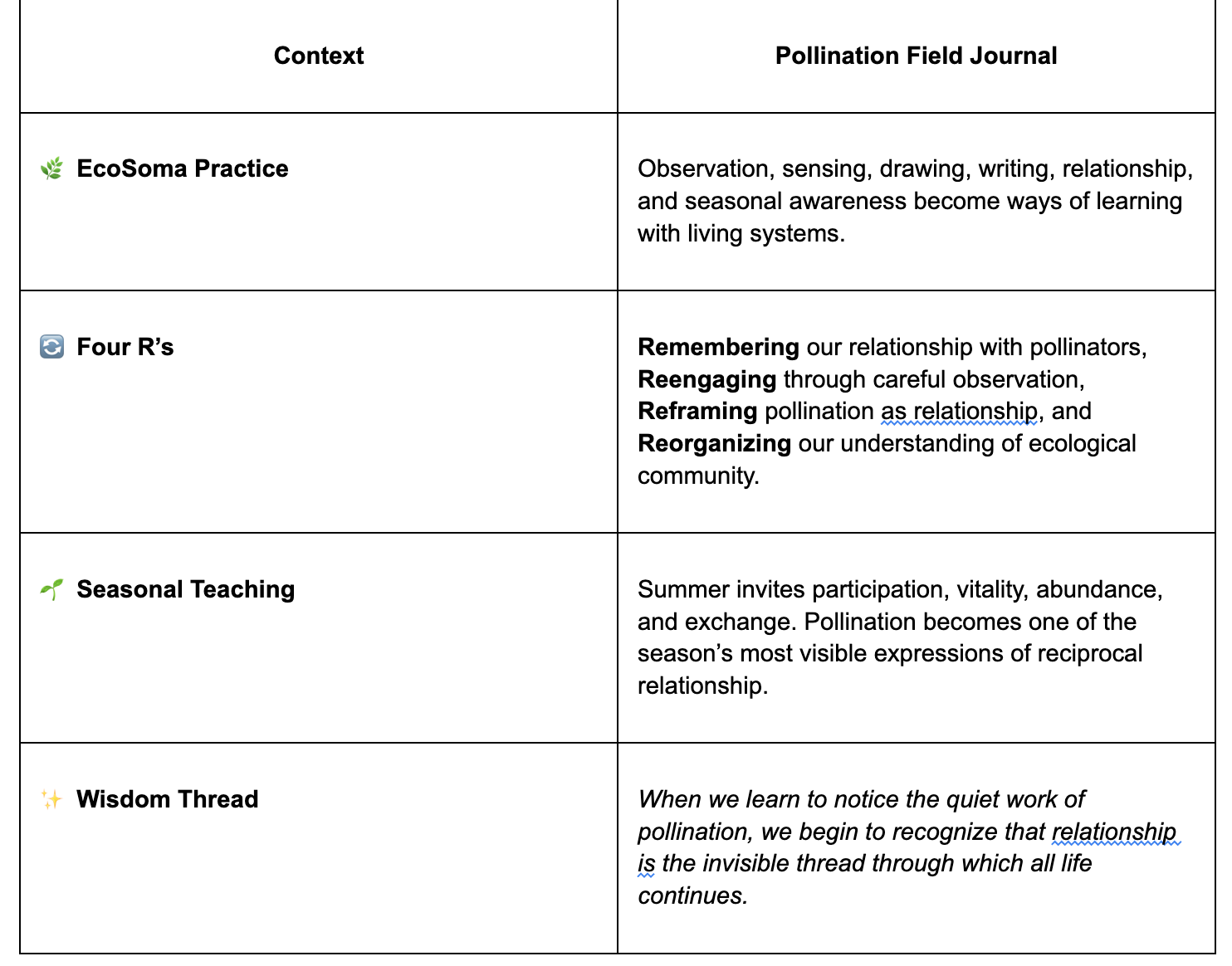
🧡 Reflection
Every flower tells a story.
Every pollinator continues it.
When we pause to notice these quiet exchanges, we begin to recognize that we are living within a vast community of relationships. Like the seasonal and relational pedagogy of Applied Eco-Arts, learning grows through repeated attention, participation, and return rather than through isolated facts.
01. Chapter 1 · Introduction — The Seasonal Cycles, Four R’s, Six Pathways, Natural Attraction Ecology, and the 54 Senses Overview.pdf
Our journals become more than collections of notes and sketches.
They become living records of curiosity.
Of patience.
Of seasons unfolding.
Of relationships becoming visible.
Sometimes understanding arrives through words.
Sometimes it arrives through drawings.
Sometimes it appears quietly—
when one flower,
one visitor,
and one attentive observer
share the same moment.
Make it stand out
Whatever it is, the way you tell your story online can make all the difference.
Nature teaches • We explore
We discover • We wonder •
We belong.
NatureConnect365 · Applied Eco-Arts