🌎 Invitation
As autumn moves toward winter, the landscape begins to change.
Flowers fade. Leaves settle onto the ground. Grasses turn golden and brown. Seed heads dry on their stems. Trees become increasingly bare.
To us, some outdoor spaces may appear quiet or finished for the year.
But life continues.
Beneath fallen leaves, among dried stems, inside tree bark, under logs, within soil, and between the branches of shrubs, living beings are preparing for colder days.
Some animals remain active. Some migrate. Some seek shelter. Some insects spend winter as adults, larvae, pupae, or eggs. Seeds wait for another growing season.
What looks untidy to us may be useful habitat to another living being.
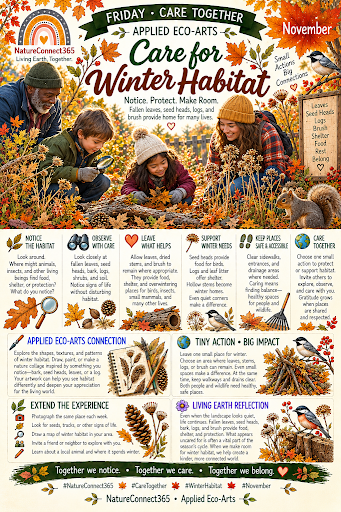
Today, explore a familiar outdoor place and look for the places where life might find food, shelter, protection, and rest during the colder months.
Before changing anything, pause and ask:
Who might need this place through winter?
🌿 What You’ll Need
A garden, yard, park, woodland edge, schoolyard, community space, or other outdoor place
Comfortable clothing for the weather
Gloves, if desired
A magnifying glass, if available
Paper or a nature journal
Pencil, colored pencils, or simple drawing materials
A camera, if desired
A small container of water for an appropriate outdoor water source, if needed
Curiosity about hidden and overlooked habitat
A willingness to observe before disturbing
💚 Care Together
Begin with a slow walk through your chosen place.
Imagine that you are much smaller.
What would the landscape look like if you were a beetle moving beneath the leaves?
A bird searching for seeds?
An insect tucked inside a hollow stem?
A small animal looking for shelter beneath shrubs?
Look carefully at the different layers of the place.
Notice the ground.
Notice fallen leaves.
Notice dried grasses and flowers.
Notice shrubs, trees, bark, logs, stones, seed heads, brush, and sheltered corners.
Then consider what kind of care the place needs.
You might:
Leave some fallen leaves beneath trees and shrubs.
Allow appropriate dried stems and flower heads to remain standing.
Leave seed heads available for birds and other wildlife.
Protect a quiet brushy or naturalized corner.
Avoid disturbing logs, bark, leaf litter, or other sheltered spaces unnecessarily.
Notice holes, crevices, cavities, or protected areas without reaching inside.
Keep appropriate water sources clean and available.
Move human-made litter away from habitat areas.
Reduce unnecessary disturbance in places where animals may be sheltering.
Observe a habitat space and simply leave it as you found it.
You do not need to create an elaborate wildlife habitat today.
Begin by recognizing the habitat that already exists.
Sometimes the most helpful action is allowing it to remain.
👀 Notice
As you explore, ask yourself:
Where might a small animal find shelter here?
Where could an insect spend the winter?
Which plants still hold seeds?
What is happening beneath the fallen leaves?
Where might birds find food?
Which places are protected from wind or weather?
Can you find holes, crevices, hollow stems, bark, logs, or dense vegetation?
Which parts of this place seem highly managed?
Which areas have been allowed to remain a little wilder?
What might happen if every leaf, stem, seed head, log, and brushy corner were removed?
Listen, too.
The soundscape may be different now.
Perhaps there are fewer insects.
Perhaps you hear migrating or wintering birds.
Perhaps dry grasses rustle.
Perhaps leaves scrape across the ground.
Perhaps the quieter landscape allows you to hear something you missed during summer.
Notice what is still here.
🎨 Applied Eco-Arts Connection
Winter habitat can be explored through shape, shelter, pattern, and imagination.
Choose one small habitat feature that attracts your attention.
A curled leaf.
A hollow stem.
A cluster of seed heads.
A piece of bark.
A cavity in a tree.
The protected space beneath a shrub.
A pile of leaves.
A tangle of grasses.
Look closely without disturbing it.
Notice its shape.
Where is the opening?
Where is it protected?
What textures surround it?
Where might wind enter?
Where might water collect?
Where could a tiny living being hide?
Then make a simple Habitat Portrait.
Draw the space as you see it, trace its shapes in your journal, or use words and marks to represent its textures and patterns.
You might add:
Shelter is…
Protection looks like…
If I were very small, I might rest…
You can also create a temporary frame around the habitat using already-fallen twigs or leaves, helping others notice the space without touching or entering it.
Remove the frame when you are finished or allow the materials to return naturally to the landscape.
Applied Eco-Arts invites us to use creativity to make overlooked relationships visible.
The artwork is not the habitat.
The habitat is what teaches us to see.
🌎 Tiny Action • Big Impact
Leave one small place for winter.
Choose an appropriate area where natural materials can remain relatively undisturbed.
It might be:
Leaves beneath a tree.
Dried stems in a garden bed.
Seed heads left standing.
A protected patch of grasses.
A log left in place.
A small brushy corner.
A naturalized area beneath shrubs.
You do not need a large yard or elaborate wildlife garden.
Even small spaces can contribute to a larger network of habitat.
At the same time, community care includes keeping sidewalks, entrances, drainage areas, play spaces, and frequently traveled paths safe and accessible.
Stewardship asks us to notice both needs.
Where do people need clear access?
Where can other living beings have space?
Where might the two coexist?
Sometimes care means tending.
Sometimes care means protecting.
Sometimes care means leaving enough alone.
🌱 Extend the Experience
Choose one small winter habitat area and observe it throughout the season.
Photograph the same habitat once each week and notice what changes.
Look for seeds that remain on plants after flowering has ended.
Watch which birds visit seed heads, shrubs, trees, or leaf-covered ground.
Draw a map showing possible winter shelters in your yard, park, schoolyard, or neighborhood.
Compare a highly maintained area with a more naturalized one.
Observe a fallen log without turning it over or disturbing what may be living beneath it.
Look closely at tree bark and notice cracks, crevices, lichens, mosses, and other small spaces.
Research one local animal or insect and learn where it spends winter.
Create a small sign reminding others that an intentionally natural area provides habitat.
Invite family members or neighbors to choose one appropriate area that can remain a little wilder.
Return during winter and look for tracks, feeding signs, birds, or other evidence that the habitat is being used.
🌼 Living Earth Reflection
As autumn becomes quieter, it can be easy to imagine that the living world is disappearing.
But winter does not mean the relationships have stopped.
Life changes its rhythm.
Some beings travel.
Some remain active.
Some shelter.
Some become still.
Some wait as seeds, eggs, larvae, or other forms of possibility.
And the landscape holds them.
Leaves become blankets.
Stems become shelter.
Seeds become food.
Bark becomes refuge.
Shrubs interrupt wind.
Soil holds roots, fungi, insects, moisture, and countless lives beyond our immediate sight.
What looks finished may still be serving a purpose.
What looks messy may be shelter.
What appears empty may be inhabited.
Caring for winter habitat asks us to loosen our desire to manage every part of the landscape.
Before cutting, clearing, raking, moving, or tidying, we can pause.
We can look more closely.
We can ask who else belongs here.
And sometimes, after paying attention, we may discover that the most generous thing we can do is very little.
We notice where life finds shelter. We protect what continues to sustain it. We make room for our wild neighbors.
#ShareGratitude #GratitudeLight #NatureConnect365 #AppliedEcoArts #AutumnGratitude #NatureGratitude #GratitudePractice #NatureConnection #SeasonalLiving #MindfulNature #CommunityCare #Belonging #GratitudeWithKids